
 Image 1 of 1
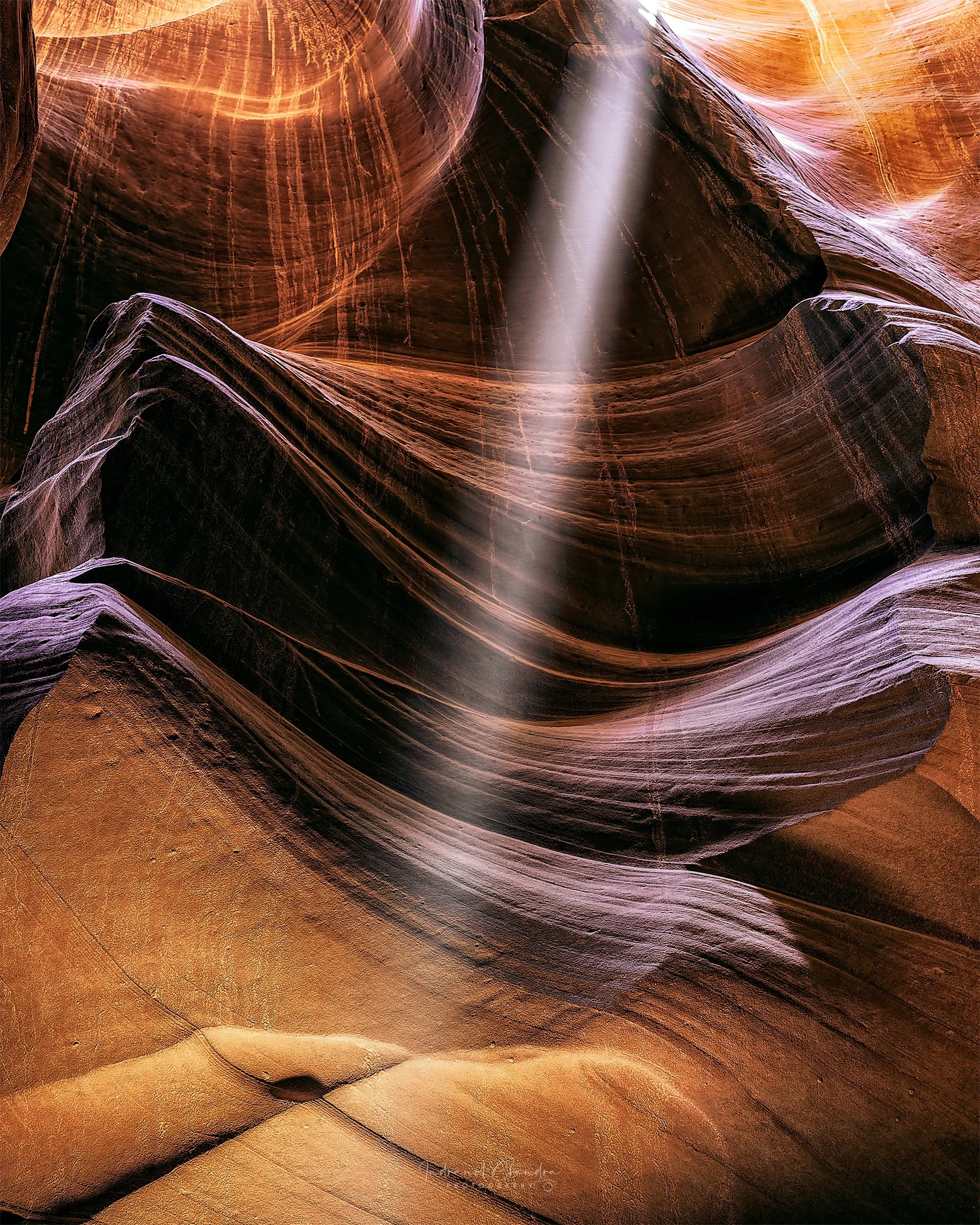
Upper Antelope, but pointed at the wall rather than the floor. Here the shaft passes across the frame instead of landing in it, and the interest is what it does on its way through — grazing one face of the corridor at a shallow angle so the ribbing on the sandstone throws its own small shadows, and leaving the opposing wall lit only by what bounces back. Handheld, in the few minutes the alignment lasted.
The fine parallel lines the light is grazing are older than they look. Around 190 million years ago this was a sand sea, one of the largest dune fields in Earth's history. Each dune had a steep lee face down which sand avalanched, and every avalanche left a layer; buried and cemented, those layers survive as cross-bedding. They weather at slightly different rates, leaving a ridged surface that raking light finds and flat light would lose. Every line here is the preserved face of a dune that stood for a season.
Standard Acrylic — Light travelling through the panel is what this frame wants: the shaft gains real luminosity, and the violet ribbing holds its relief rather than flattening into the shadow behind it. The range from open beam to near-black stays continuous, with no banding through the amber. Glossy (OP3) is the high-gloss option, maximum depth and vibrancy with premium UV filtering; matte (P99) is anti-glare, holding balanced sharpness and the same UV protection with reflections removed.
Also available in: TruLife Acrylic version · ChromaLuxe Metal version · Gallery Metal version · Fine Art Paper version
Made to order · Allow 3–5 weeks for production and delivery · Shipping charged at cost, never marked up · Shipping & Returns
The watermark shown here protects the online image only. Your print arrives clean.
Upper Antelope, but pointed at the wall rather than the floor. Here the shaft passes across the frame instead of landing in it, and the interest is what it does on its way through — grazing one face of the corridor at a shallow angle so the ribbing on the sandstone throws its own small shadows, and leaving the opposing wall lit only by what bounces back. Handheld, in the few minutes the alignment lasted.
The fine parallel lines the light is grazing are older than they look. Around 190 million years ago this was a sand sea, one of the largest dune fields in Earth's history. Each dune had a steep lee face down which sand avalanched, and every avalanche left a layer; buried and cemented, those layers survive as cross-bedding. They weather at slightly different rates, leaving a ridged surface that raking light finds and flat light would lose. Every line here is the preserved face of a dune that stood for a season.
Standard Acrylic — Light travelling through the panel is what this frame wants: the shaft gains real luminosity, and the violet ribbing holds its relief rather than flattening into the shadow behind it. The range from open beam to near-black stays continuous, with no banding through the amber. Glossy (OP3) is the high-gloss option, maximum depth and vibrancy with premium UV filtering; matte (P99) is anti-glare, holding balanced sharpness and the same UV protection with reflections removed.
Also available in: TruLife Acrylic version · ChromaLuxe Metal version · Gallery Metal version · Fine Art Paper version
Made to order · Allow 3–5 weeks for production and delivery · Shipping charged at cost, never marked up · Shipping & Returns
The watermark shown here protects the online image only. Your print arrives clean.