
Wildlife
Wildlife photography, for me, is an act of reverence—a way to witness and give form to the untamed spirit of the wild. I focus on the birds and mammals of the Americas and Asia, each encounter offering a moment of connection with a living world that moves with both grace and ferocity. My work aims to capture not only the fleeting beauty of an animal in motion, but also the pride and presence it carries in its natural environment.
Through the lens, I seek the balance between elegance and survival, intimacy and distance. Each image reflects my attempt to share the sense of awe I feel when the wild reveals itself — an invitation to see these beings not as subjects, but as sovereign creatures inhabiting their rightful place in nature’s larger story.

Indian sambar at Ranthambhore National Park, Rajasthan. We had been parked for over an hour watching a patch of scrub where a tiger was said to be lying up, and nothing came out of it. I turned round and found this stag standing a short way behind the vehicle, entirely still, watching us watch the bushes. Sambar are the largest deer in Asia — a mature stag stands about 5 feet (1.5 m) at the shoulder and can weigh 700 pounds (320 kg) — and in Ranthambhore they are the tiger's principal prey. Their alarm call is what everyone in the park is really listening for; a sambar barking into the trees locates a tiger faster than any amount of watching does. The antlers carry three points to a side and are shed and regrown annually, among the fastest-growing tissue of any mammal — the ridging and wear visible on them is a single season's work. In monochrome the picture comes down to separation: pale antler against dark out-of-focus scrub, and a coat running from near-black at the shoulder to grey at the muzzle, with no colour available to hold the two apart. Enlarged, the coarse coat and the grain of the antler both hold their texture, down to the fine hair along the ear and the wet of the muzzle.

Ranthambhore National Park, Rajasthan, late afternoon, the light gone warm and low. This tiger was lying up in the open, unhurried, aware of the vehicle and entirely unconcerned by it. Made at around 400mm, close enough to fill the frame with head and shoulders and let the dry ground and rock behind fall away into bands of ochre and rust. The coat reads as vivid orange to us, but not to the animals it hunts. Deer are dichromats — they see blues and yellows and cannot separate orange from green — so a tiger crossing open ground appears to its prey in much the same tone as the vegetation around it. The colour that makes this animal conspicuous in a photograph is camouflage to everything that matters. The stripes work on the same principle, breaking the outline into vertical bands that match standing grass; no two tigers carry the same pattern, which is how individuals are identified in the field, and the marking runs into the skin rather than sitting only in the fur. Warm late light of this kind puts coat and background in the same register, so the picture depends on the face to hold it — the whiskers as separate lines, the eyes keeping their detail, the fine white fur around the muzzle separating cleanly from the black.

Ranthambhore National Park, Rajasthan, late afternoon, on one of the small lakes inside the park. The water had gone a flat dark grey, and an Oriental darter was up on a stump at the edge of it with its wings held fully open — around 3½ feet (1.1 m) across — drying. It's an attitude the bird holds for many minutes at a time, and one that gives an almost symmetrical shape against an empty background. Most waterbirds float high and stay dry. The darter does neither. Its outer feathers are structured to let water in rather than shed it, so the plumage soaks through on every dive; the bird loses buoyancy and hangs low in the water, often with nothing but the neck and head showing — which is where the name snakebird comes from. That wettability is what makes it an underwater hunter rather than a surface one, and the cost is that it cannot fly efficiently until it has dried out, hence the spread wings. It hunts by spearing rather than seizing, and the neck carries a hinge at the eighth vertebra that folds back and releases like a trigger to drive the bill through a fish. Against water reduced to a single flat tone, the picture has nowhere to hide — the whole of it is the bird. The silver shafts on the wing coverts, the individual primaries, and the fine texture of the neck are what carry it.
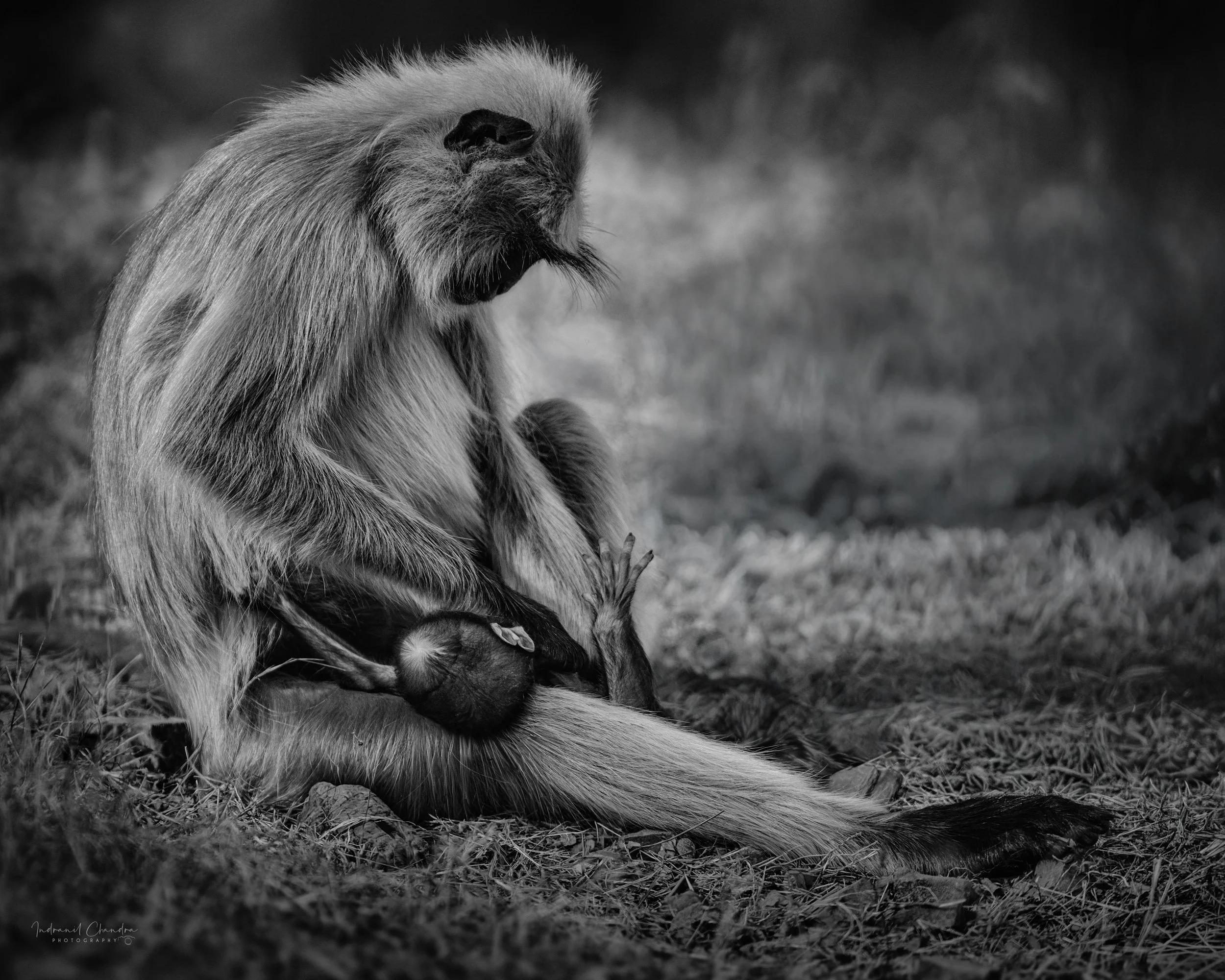
Rajasthan, on open ground at the edge of the forest. A grey langur female was sitting on the grass with an infant across her lap, working through its fur, and neither of them paid the slightest attention to being watched. The tail runs out behind her nearly the length of the frame — on an adult it can exceed 3 feet (1 m), longer than the body it belongs to. The picture seems to capture a moment of tenderness between mother and child, and that reading is ours rather than hers. What she is doing is grooming: working through the coat for parasites and debris, an activity langurs spend a large part of the day on. It matters socially — grooming is how rank and alliance get negotiated in a troop — but it is maintenance before it is affection, and the posture that reads as devotion is also the most practical way to hold a small animal still. The infant is the darker of the two, and that is not a trick of the light. Grey langurs are born almost black and hold that natal coat for the first three to five months before it fades to adult grey; the contrast marks a new infant unmistakably to the rest of the troop, which handles them freely — other females take and carry newborns within hours of birth. In monochrome that difference does the compositional work, near-black against pale grey with no colour needed to separate them.

The backwaters of the Napo, in the Ecuadorian Amazon — a slow side channel off the main river where the surface goes to glass. A caiman was holding station with only the top of its skull above water, and a beetle had settled at the base of its snout just forward of the eye, along for the ride. The caiman did nothing about it. Insects do exploit crocodilians directly — bees and butterflies have been filmed drinking caiman tears for the salt and protein they can't get from nectar, a behaviour called lachryphagy. Whether this beetle wanted anything at all is another matter. Shot down low, close to the waterline, so the reflection sits directly beneath the head and the two read as one continuous shape. Everything a caiman needs above water sits on a single plane: eyes, ears and nostrils are all mounted on the upper surface of the skull, so it can float with the rest of the body submerged and lose almost nothing. The eye is built for the same dim, tannin-stained water — a vertical pupil that opens wide after dark, and a reflective layer behind the retina that returns light through the photoreceptors a second time, which is what makes caiman eyes glow when a torch finds them at night. The raised bony ridges around the orbit are armour, and that is where the beetle has chosen to sit.
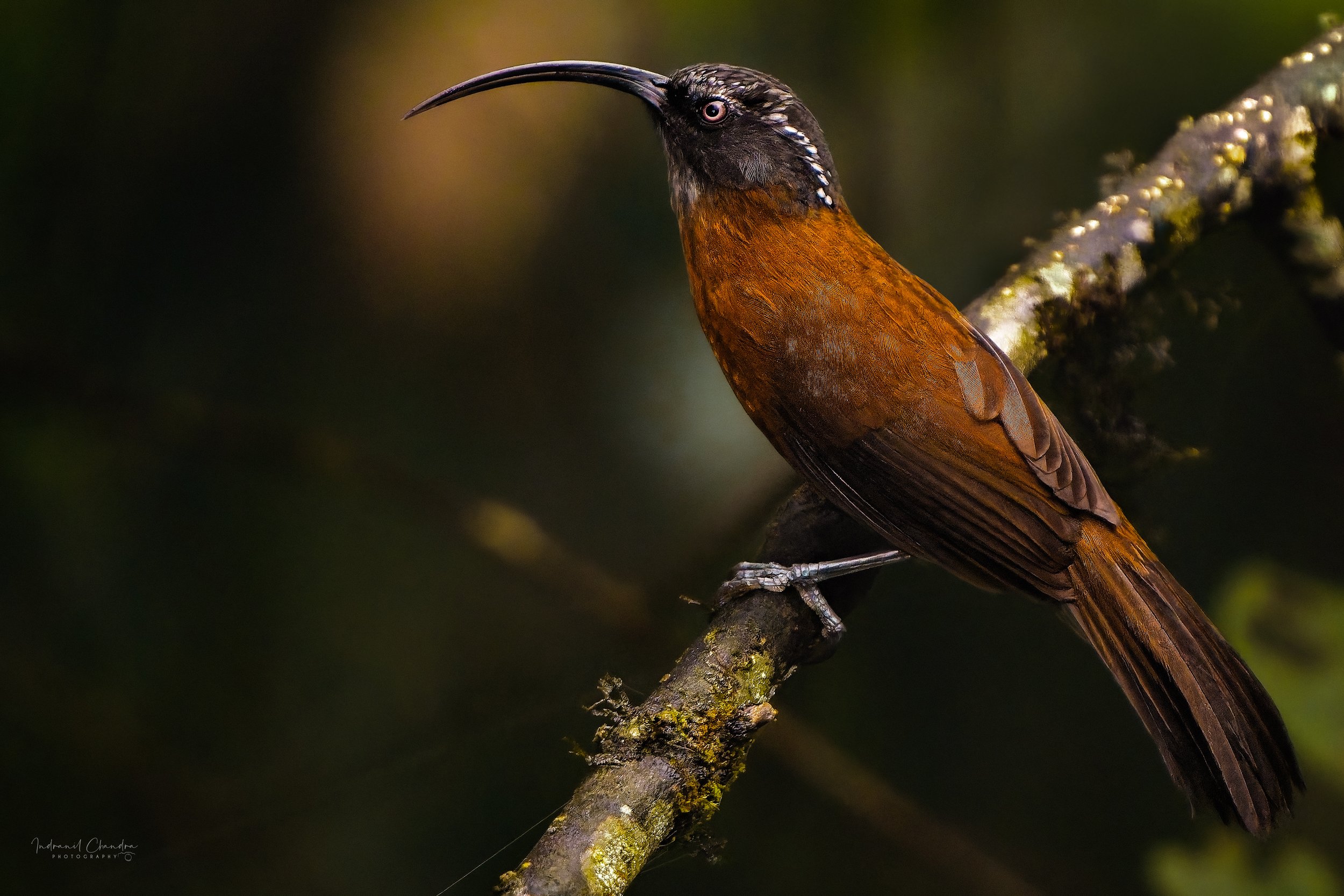
Tendong Forest, South Sikkim — dense hill forest with a thick understorey of bamboo and moss. This is a bird that spends almost all its time inside that tangle, working the leaf litter and low stems, and it is heard far more often than seen. This one came up onto an open branch and stayed long enough for a clean frame against the shade behind it. The bill stands out. It is close to 2 inches (5 cm) long on a bird of about 8 inches (20 cm), sharply decurved, and among the longest of any babbler — a probing tool for reaching into moss cushions, rotting wood and the cavities at the base of bamboo stems where invertebrates shelter. The species is confined to a narrow altitudinal band of the eastern Himalayas and rarely leaves cover, which is why photographs of it are uncommon. Against a background thrown to a soft wash of green and gold, the picture is carried by the line of the bill and the separation of the rufous underparts from the dark head.
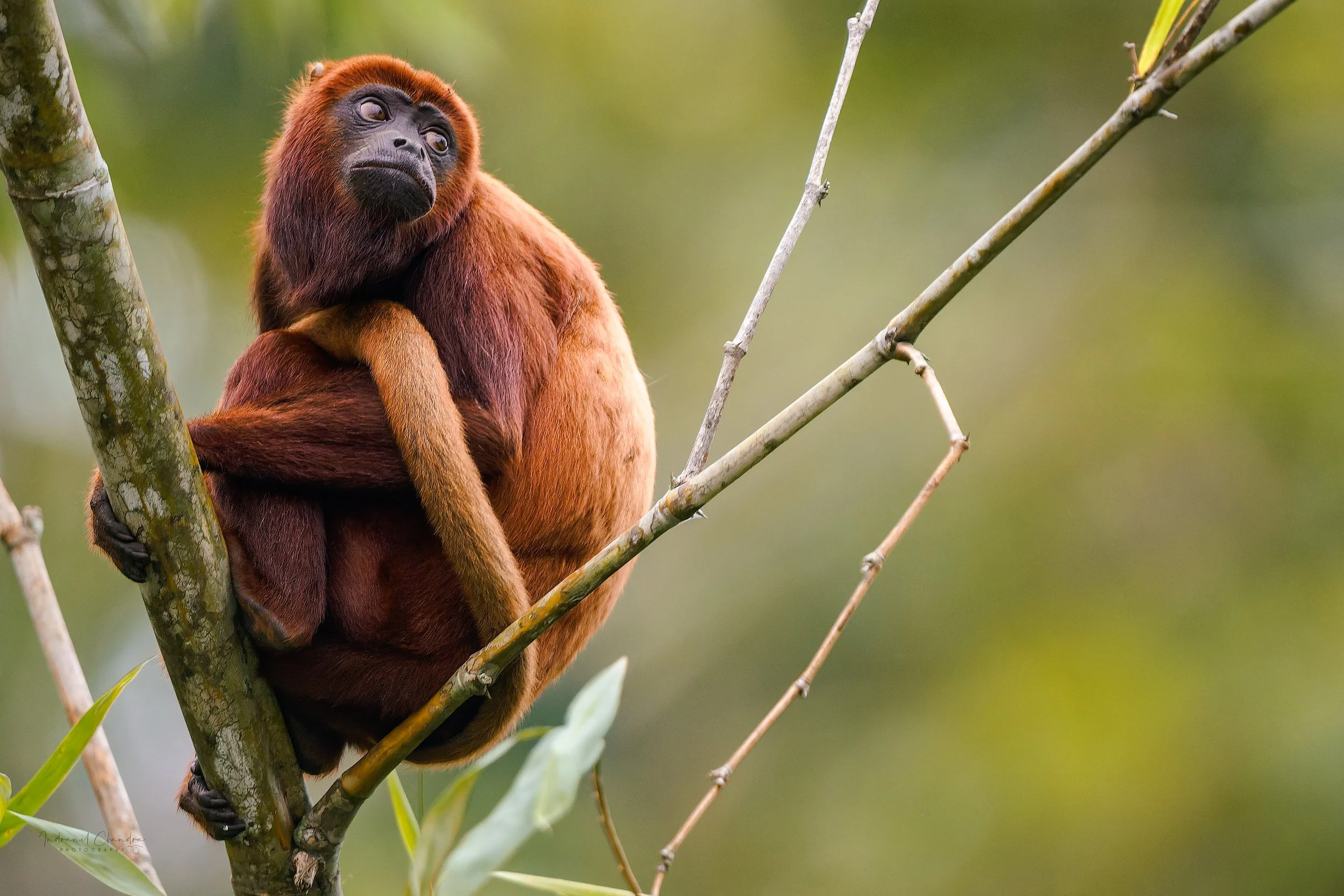
Ecuadorian Amazon, in a stand of bamboo, a red howler monkey wedged into a fork with its limbs drawn in and its eyes turned up toward something above. The tail is doing as much work as the hands — it crosses the chest, runs down the far side and grips the stem below, a fifth limb with a bare, ridged pad on the underside for purchase. Howlers spend most of the day arranged like this. The stillness is a consequence of diet. Howlers live largely on leaves, which yield little energy and take a long time to ferment in an enlarged gut, so the animal conserves what it has and rests for the better part of the day. The sound they are named for costs them almost nothing by comparison: a hollow, enlarged hyoid bone in the throat acts as a resonating chamber, and the resulting call carries roughly 3 miles (5 km) through closed forest — loud enough that troops can space themselves apart without ever meeting. The colour is the other thing the frame is built on: dense rufous fur against green, one of the few genuinely warm subjects in a rainforest. At scale the coat separates into individual hairs, lighter at the edges where light passes through them, and the bare dark face — much smaller than the mass of fur around it — stays the fixed point the eye returns to.
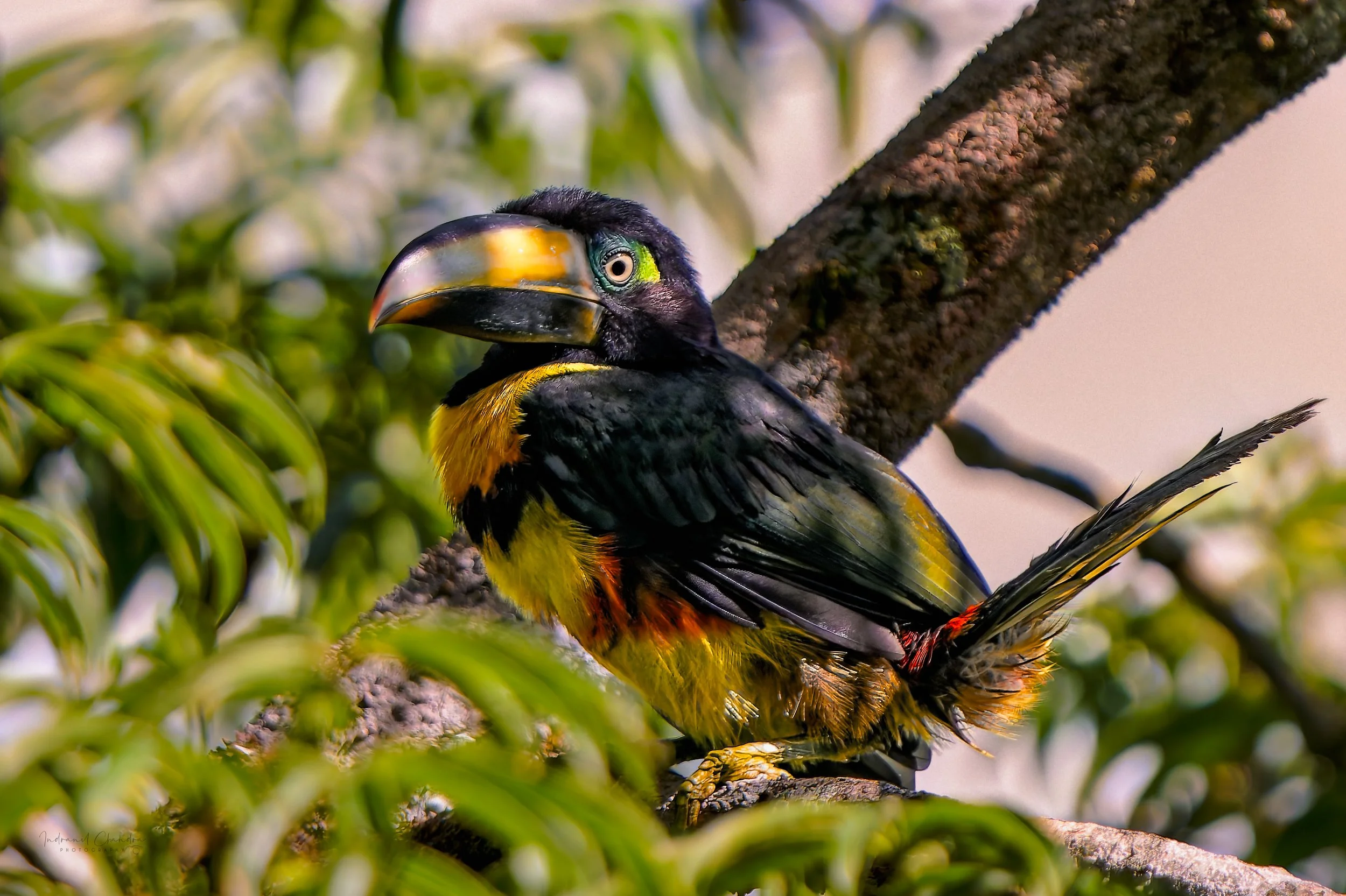
A many-banded aracari in the Ecuadorian Amazon, high in a fruiting tree in hard mid-morning light. A small member of the toucan family, and this one was preening — the frame catches the middle of a shake, body feathers lifted and out of order, tail fanned sideways with the shafts separated, one foot forward on the branch. Not a composed portrait; the plumage is doing something rather than sitting still. The bill looks like it should be a burden and isn't. Under the keratin sheath it is mostly air — a lattice of thin bony struts bracing a hollow interior, so a structure running close to a third of the bird's roughly 17-inch (43 cm) length weighs very little. It works as a reach extender, letting the bird take fruit from thin outer twigs that will not hold its weight, and as a radiator: blood flow to the surface can be opened or shut to shed heat, which matters in a climate that offers no other relief from it. The ring of bare skin around the eye is doing something similar, running teal into green in a band no feather could produce. Everything here is packed into a small area of the frame, and it holds up under enlargement: the polished translucence at the bill tip, the red flush at the base of the tail, and the individual separated shafts of the fanned feathers all stay distinct against the soft green behind.
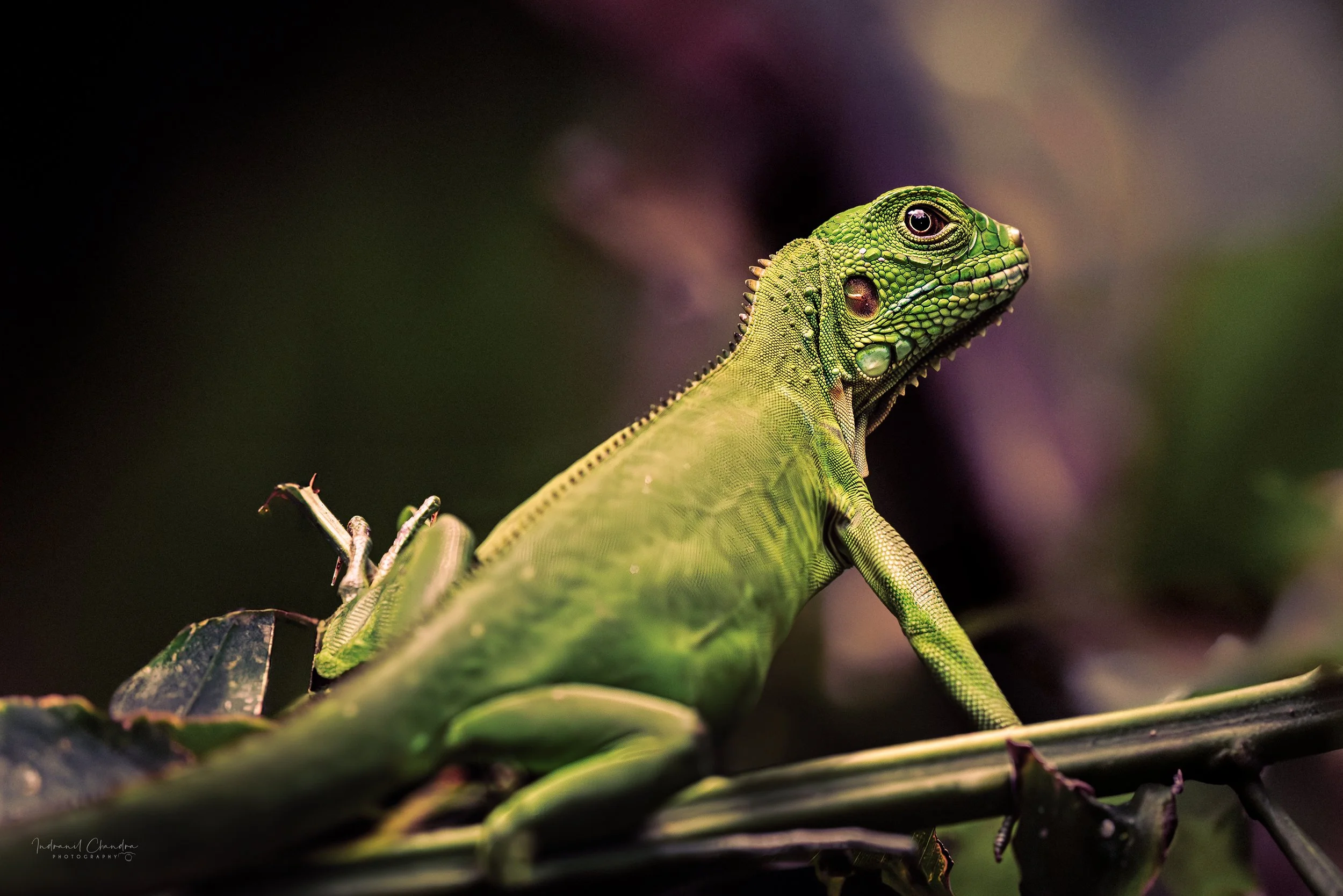
Manuel Antonio National Park, Costa Rica, on a low branch in filtered forest light. A green iguana, doing what iguanas mostly do — holding still in a patch of warmth, head raised, letting the day get on with itself. Bright green like this indicates a young animal; adults dull toward grey and, in some populations, orange. On top of the skull, out of view in this profile, green iguanas carry a parietal eye — a genuine third eye, with a rudimentary lens and retina, wired not for vision but for detecting changes in overhead light. A shadow crossing it means something is above, which for an animal that spends its life on branches under raptors is the warning that matters. What the profile does show is the rest of the arboreal kit: the serrated dorsal crest, the dewlap under the jaw for display and for shedding heat, the large round plate on the cheek that identifies the species, and the fine granular scaling that runs unbroken from snout to shoulder. An iguana this age has recently done something odd to earn its living — green iguanas digest leaves by fermentation in the hindgut, and hatchlings are born without the microbes for it, so they climb into the canopy, find older iguanas, and eat their droppings to acquire the gut community. Without that contact they never develop it properly. The frame is a study in one colour — green animal, green surround — so it depends on scale texture to separate subject from setting, and that is what rewards a large print: the individual scales, the ringed pattern on the limb, and the eye holding its detail against the soft wash behind.

Corcovado National Park, Costa Rica, in the middle of the day. A northern tamandua — the collared anteater — up on a horizontal limb, head lowered, claws hooked over the top of the bark. Made at 700mm from the ground, the only way to get near an animal working that high; mid-day light in closed forest arrives in patches, and this one had found a lit section of branch with the canopy behind it falling to almost nothing. The claws explain the posture. The front ones are long enough that a tamandua cannot put its palms down — it walks on the outsides of its wrists with the claws folded inward, and hooks them over branches rather than gripping them. They are digging tools first, for breaking into ant and termite nests, and the animal has no teeth at all to follow up with. What goes in instead is a tongue up to 16 inches (40 cm) long, coated in sticky saliva from greatly enlarged glands in the throat and flicked in and out at speed. Feeding happens in short bursts — a minute or so at one nest before the soldier ants mount enough of a counterattack to make it not worth continuing — so a tamandua works dozens of nests in a day rather than settling at any of them. The tail is prehensile and bare on the underside; here it is wrapped round the far side of the limb as an anchor. Against forest thrown almost black, the picture is all animal, and it takes size well: the coarse guard hairs, the ridged keratin of the claws and the wet of the nose all stay separate from the dark behind.
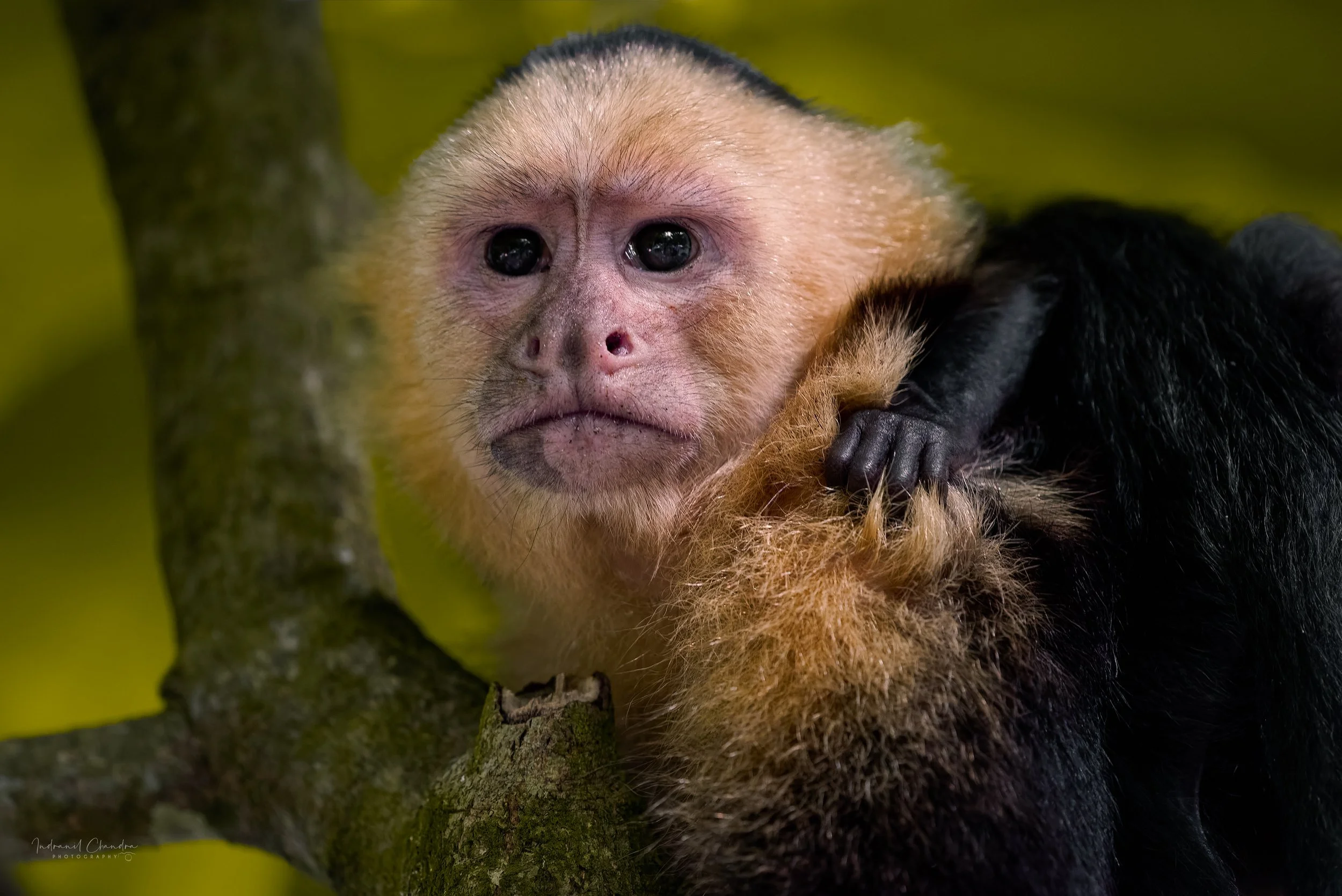
Manuel Antonio National Park, Costa Rica, at midday. A white-faced capuchin at rest, with an infant riding behind — the small black hand pressed against the adult's neck is nearly all of it that made the frame. Made at 500mm, close enough that the face fills the picture and the limb and canopy behind reduce to soft green and grey. For its size — an adult weighs around 8 pounds (3.5 kg) — the capuchin carries the largest brain relative to body of any monkey, and the reason is how it feeds. Capuchins are extractive foragers: they get at food that is hidden or protected, prising bark away, rolling logs, opening hard fruit by pounding it against a branch, and in some populations using stones as tools. None of that is instinctive. It is learned by watching, over years, which is why capuchin infants stay dependent far longer than most monkeys their size, riding on an adult's back well past the point they can move independently. The hand in this frame is doing exactly that job. The bare skin of the face is the other thing worth noticing — pale, mobile and unusually expressive for a monkey, and different enough between individuals that capuchins recognise each other by it. At scale that skin is what carries the picture: the fine hairs along the brow, the flecking on the muzzle, and the wet highlight in the eyes all hold, and the infant's hand stays a separate, distinctly smaller thing against the adult's fur.