
Nature & Landscape
Immerse yourself in the breathtaking beauty of the natural world through our Nature and Landscape photography gallery. From sweeping mountain vistas and serene lake views to the dramatic desertscapes of the U.S. Southwest , each image captures a unique moment of nature’s grandeur. These photographs are more than just visuals—they’re invitations to pause, reflect, and reconnect with the world around us. Whether you're seeking inspiration or simply a moment of calm, this collection brings the awe of the outdoors into view.
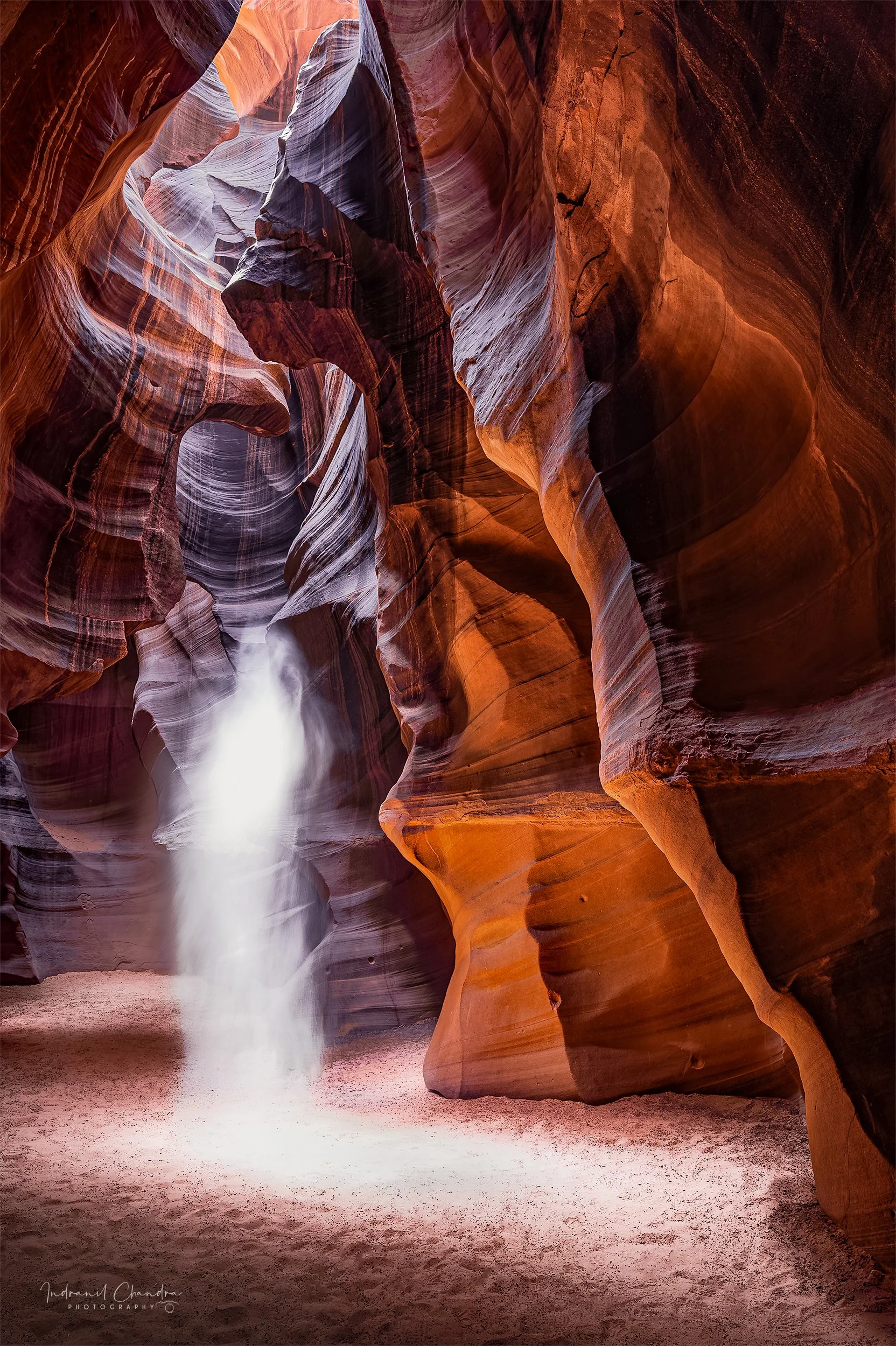
A shaft of light filters down through the sculpted sandstone walls of Antelope Canyon, catching dust thrown up by guides and the footfall of visitors moving through the slot. For a few seconds, the light shaped that dust into a ghostly white figure standing on the canyon floor — a phantom that formed, held, and was gone.
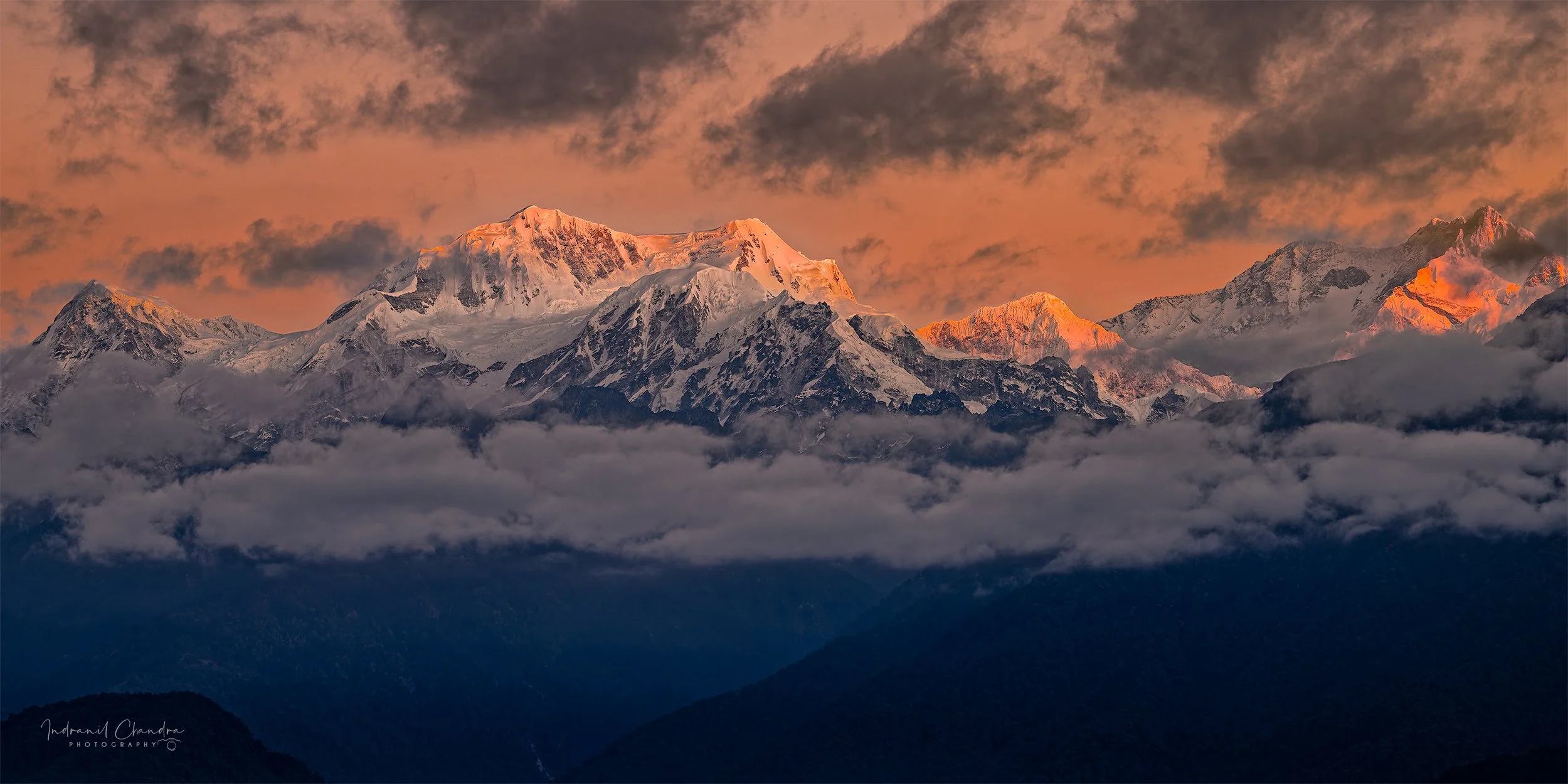
The Kanchenjunga massif catches the first light of the day, seen from Pelling in West Sikkim — its summits burning orange while the valleys below are still held in shadow. At 28,169 feet (8,586 m), Kanchenjunga is the third-highest mountain on earth and the highest in India, sacred to the people of Sikkim, who by long tradition leave its true summit untrodden.
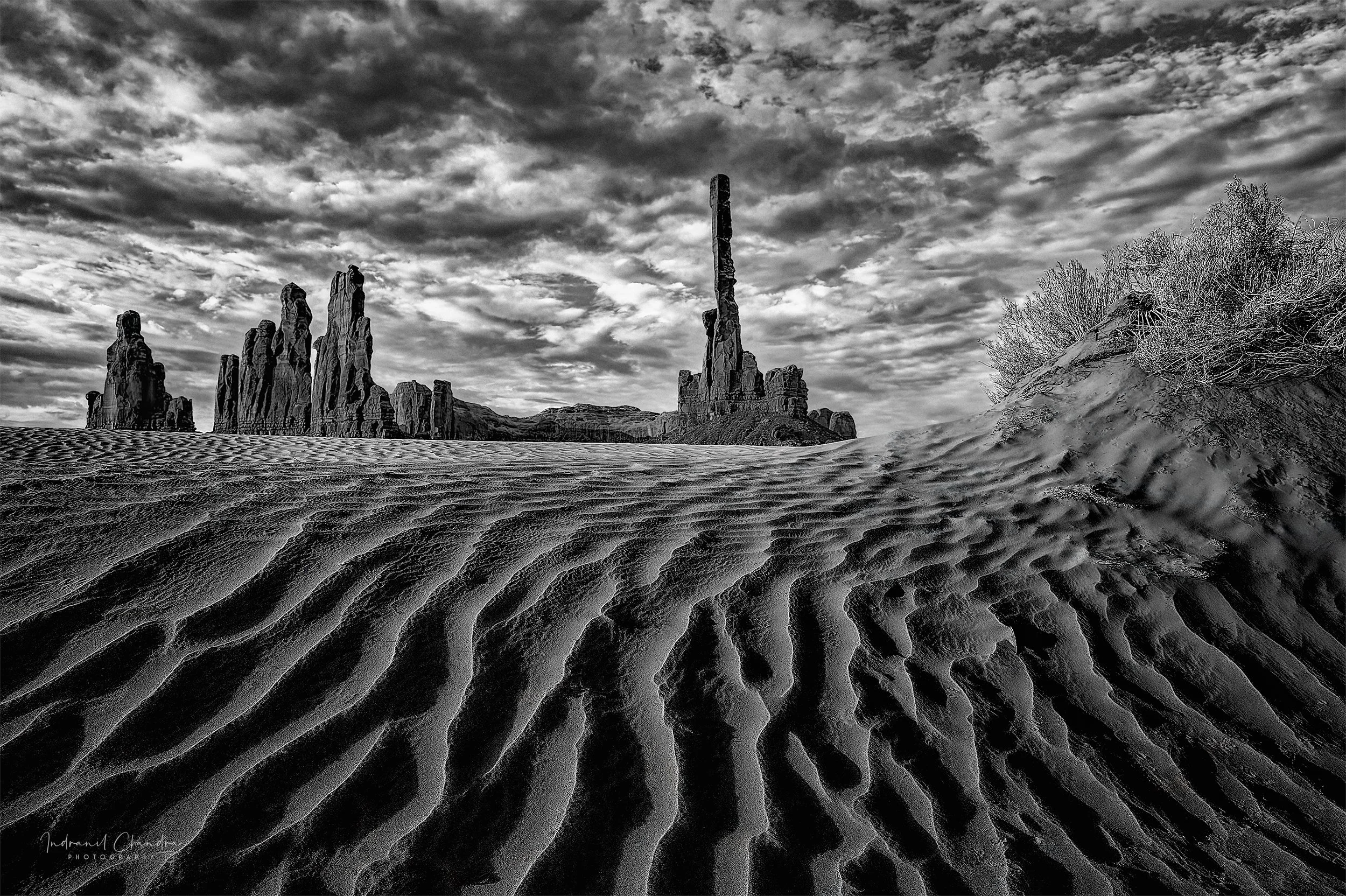
Wind-carved ripples in the sand lead the eye toward Totem Pole and the Yei Bi Chei formations, standing sentinel over Monument Valley in the early morning light. This stretch of dune sits within the Navajo Tribal Park, accessible only with a Navajo guide, and the ripples reshape themselves with every wind — the pattern in this frame existed for a matter of hours.
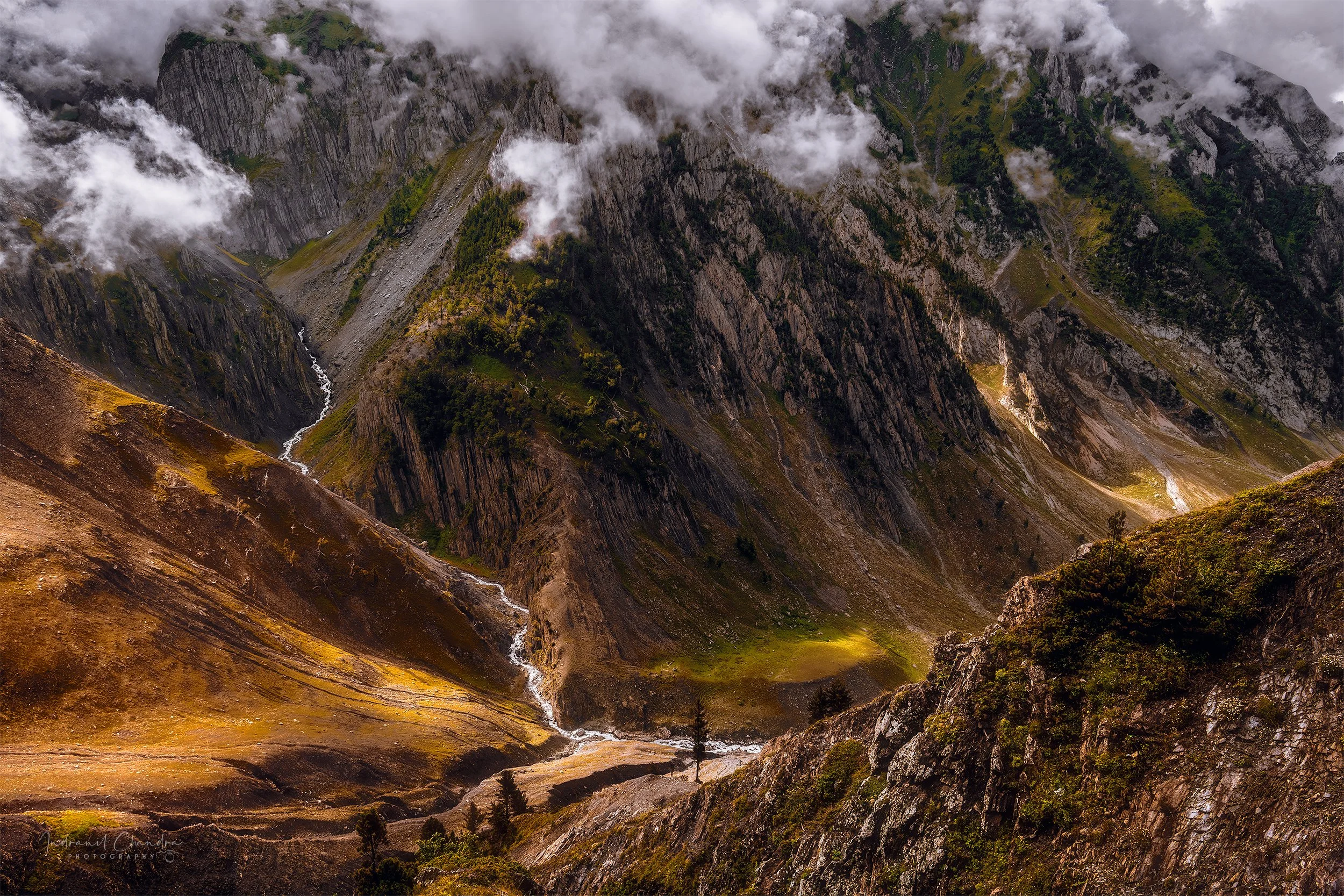
July, along the Srinagar–Leh highway, just after sunrise. We were stopped at the roadside waiting for an army convoy to pass when I looked out of the window and saw this: a meltwater stream threading down the gorge below, slopes running from bare rock to deep green in a thousand feet (300 m), cloud caught along the high ridges, and the early light finding gold in the near slopes. No tripod, no setup — just the frame, while it lasted.
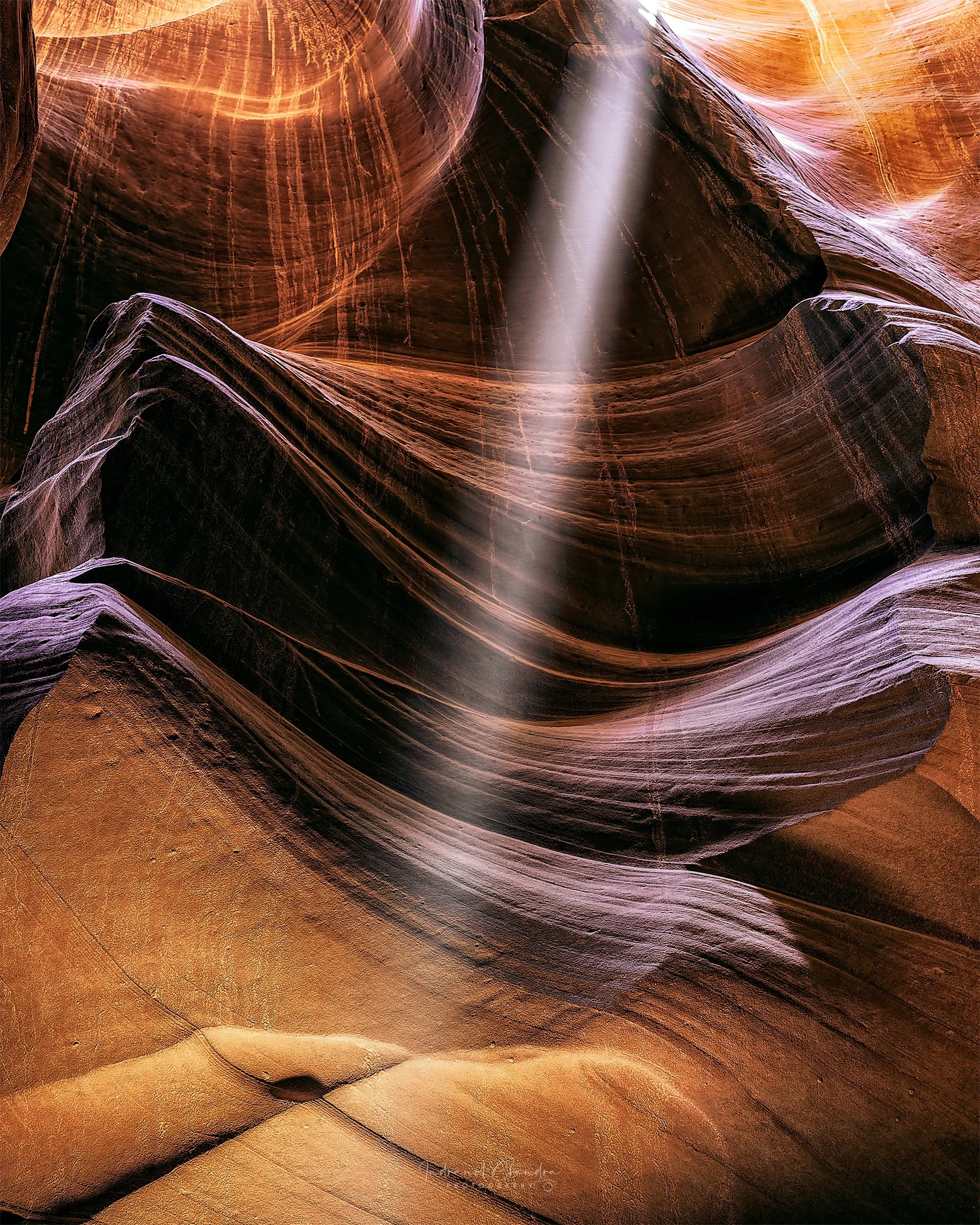
Upper Antelope, but pointed at the wall rather than the floor. Here the shaft passes across the frame instead of landing in it, and the interest is what it does on its way through — grazing one face of the corridor at a shallow angle so the ribbing on the sandstone throws its own small shadows, and leaving the opposing wall lit only by what bounces back. Handheld, in the few minutes the alignment lasted.

Late afternoon in The Narrows, where the North Fork of the Virgin River has cut a slot through Zion's sandstone over millions of years, leaving walls that rise a thousand feet and more. At this hour the sun no longer reaches the canyon floor; the light here is reflected — bounced off the sunlit rim above and thrown back down the walls, which is what gives the stone its inner glow. Reaching this stretch means wading upriver, camera and tripod through moving water, with no dry route in. The long exposure smooths the current into a dark ribbon at the base, setting the river's motion against the stillness of rock that has stood for millennia.
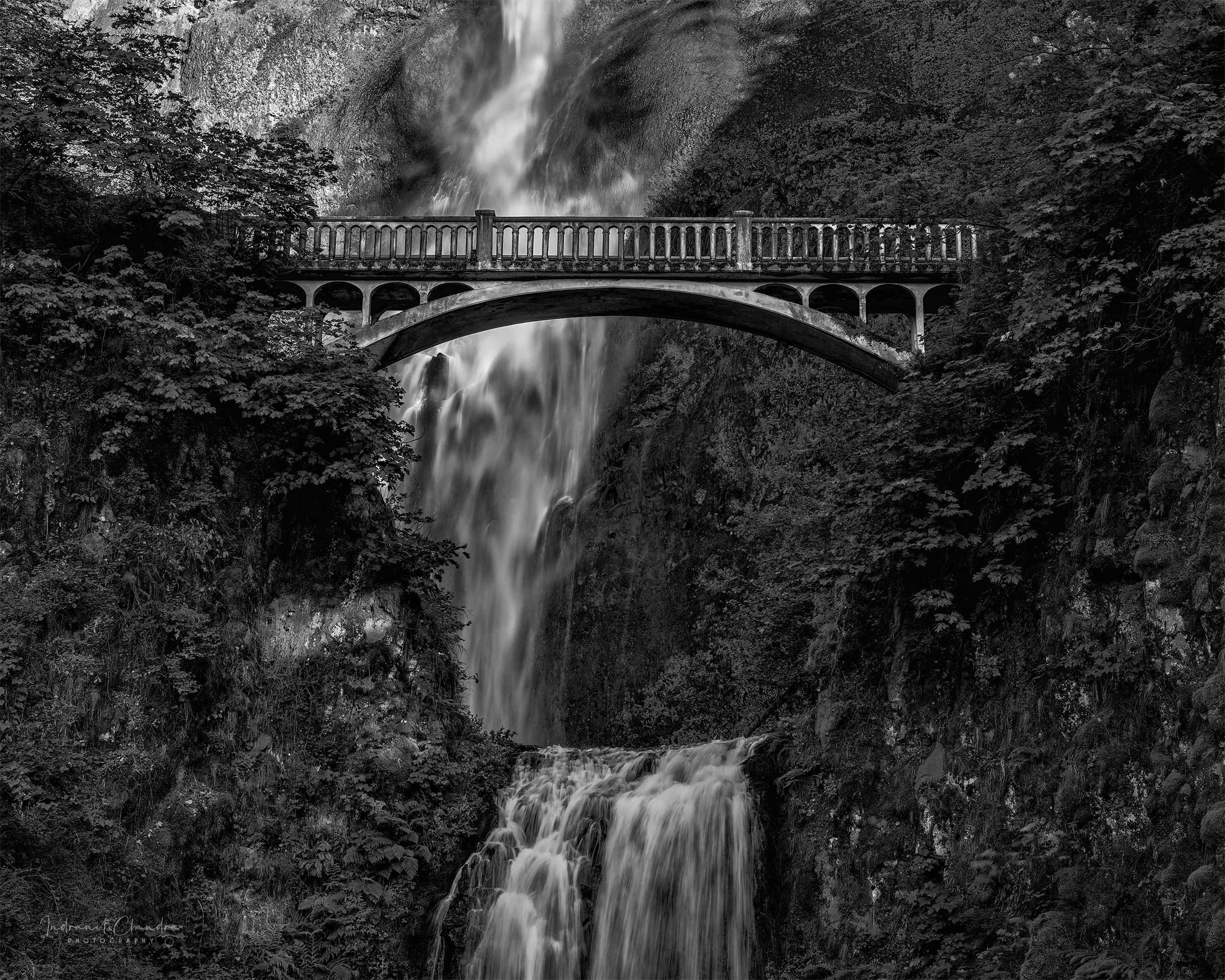
The fourth of July, and Multnomah Falls was as busy as it gets. I waited a couple of hours for the Benson Bridge to clear, and in the last of the evening light it did — a few seconds with nobody on it. The usual frame here is vertical, taking in all 620 feet (189 m) of it. I wanted the bridge and the flora instead, with the water behind them, and a landscape format held that better. Silver and stone: it doesn't need colour to hold you — just the water, the arc of the bridge, and the gorge closing in.

Lower Calf Creek Falls drops 126 feet down a wall of Navajo sandstone in Grand Staircase–Escalante, Utah, reached by a six-mile round trip along the creek bed through sand and slickrock. The wall itself is the reason to make the picture. Those vertical black and umber streaks are desert varnish: manganese and iron oxides deposited over thousands of years by water and microbial action, running down the rock like ink. By late morning the sun has climbed high enough to reach into the canyon, lighting the sandstone gold behind them, and where the spray carries, moss holds on in vivid green. A long exposure smooths the falling water into a single white column against all that texture — motion against permanence, in a frame built almost entirely of verticals.
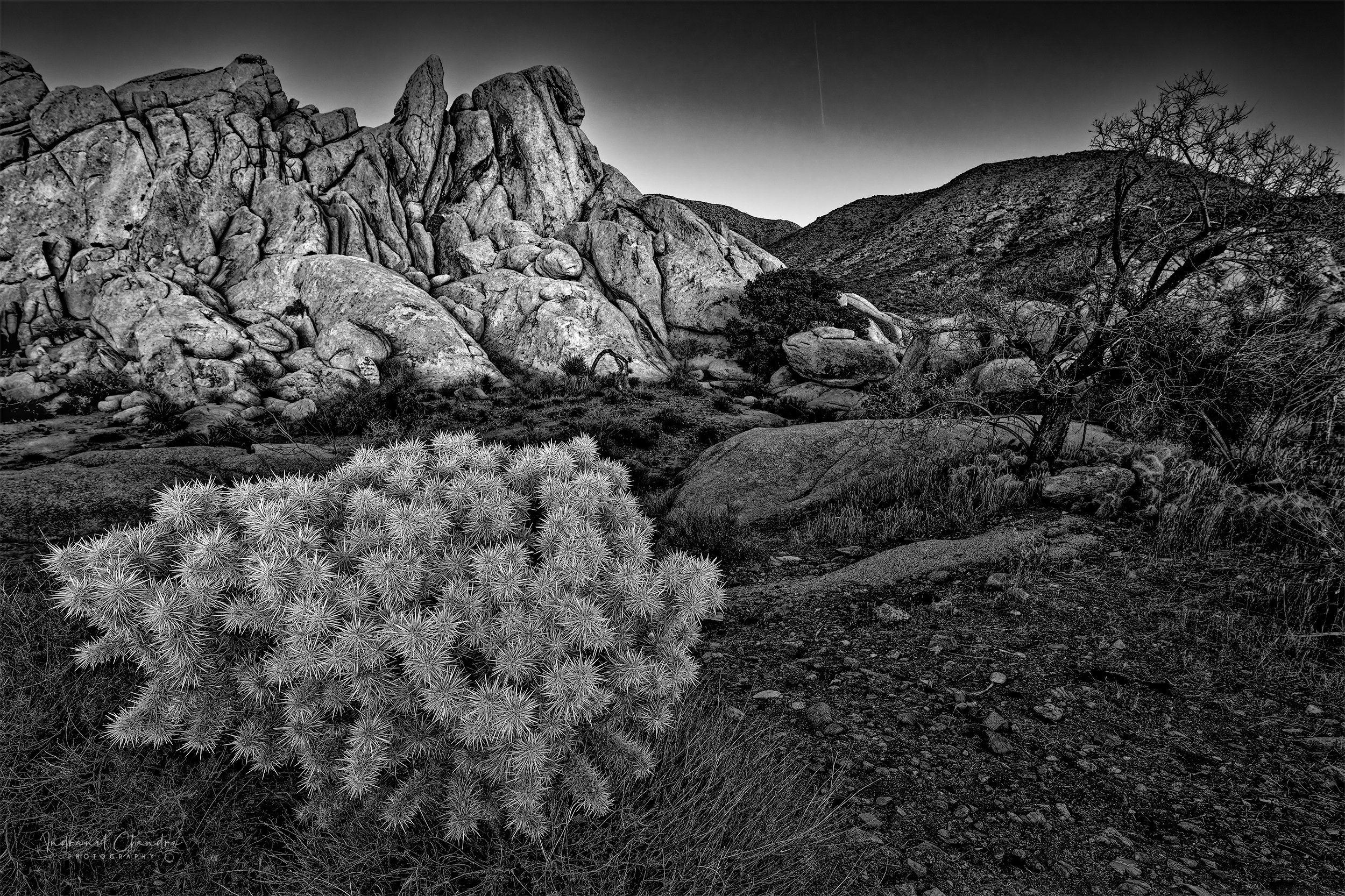
Blue hour in Joshua Tree, after the sun has gone but before the sky has given up its light. A long exposure holds the last of it — a low stand of cholla filling the foreground, its dense spines reading almost white against the dark ground, the monzogranite piles of the high desert behind, and a meteor cutting a thin line across the sky above.
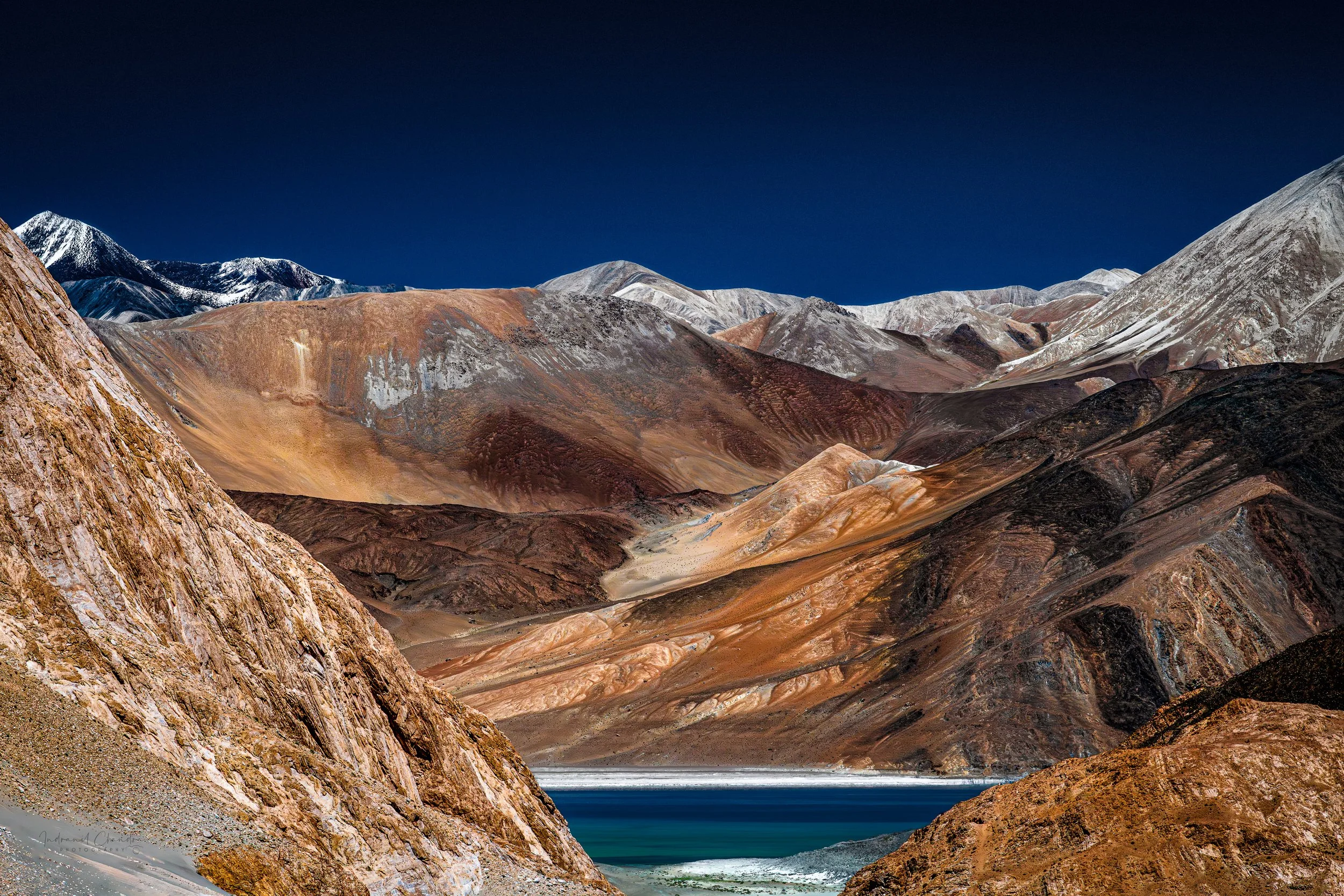
The first sight of Pangong Tso, coming south from the Nubra Valley. That road crosses glacier meltwater streams that swell through the day — cross too late and they become impassable, so the timing is fixed for you by the sun. Rounding a bend by mid-morning, the lake appears in a gap between the ridges: a band of turquoise below a wall of colour, with the Changchenmo Range rising behind. The colours in these mountains are not light effects; they're mineralogy showing through. Ladakh sits on the seam where the Indian plate drove into Asia, and the rock here is a jumble of what that collision brought up — ancient seafloor, volcanic material, granites intruded from below. The rust and ochre tones are iron-bearing minerals oxidised over millennia in dry, thin air; the purples and greys come from different sediments and volcanic rock; the pale bands are granite and salt-crusted deposits. There's almost no vegetation to soften any of it, and at 14,270 feet (4,350 m) the air holds so little moisture that the colour arrives at the lens undiminished.

Tso Moriri, on the Changthang Plateau in south-eastern Ladakh, at 15,075 feet (4,595 m). Composed as a 1:3 panorama, which is what the place asks for: the land runs flat and open to a horizon far enough away that a conventional frame would misrepresent it. The image sorts itself into four bands — dark water, the tawny sweep of the hills, snow-topped Trans-Himalayan peaks, and a sky with more cloud than Ladakh usually offers. Those golden slopes are grazing land. The Changthang is high-altitude steppe, home to Changpa herders who move pashmina goats and yaks across it. The next day, a few miles from the lake at Karzok, I came across black-necked cranes — a species that breeds on these wetlands in summer and crosses the Himalaya to winter in India. The plateau looks empty. It is not. A wide-format image made for a long wall — a room where a horizontal expanse of it can be seen whole.
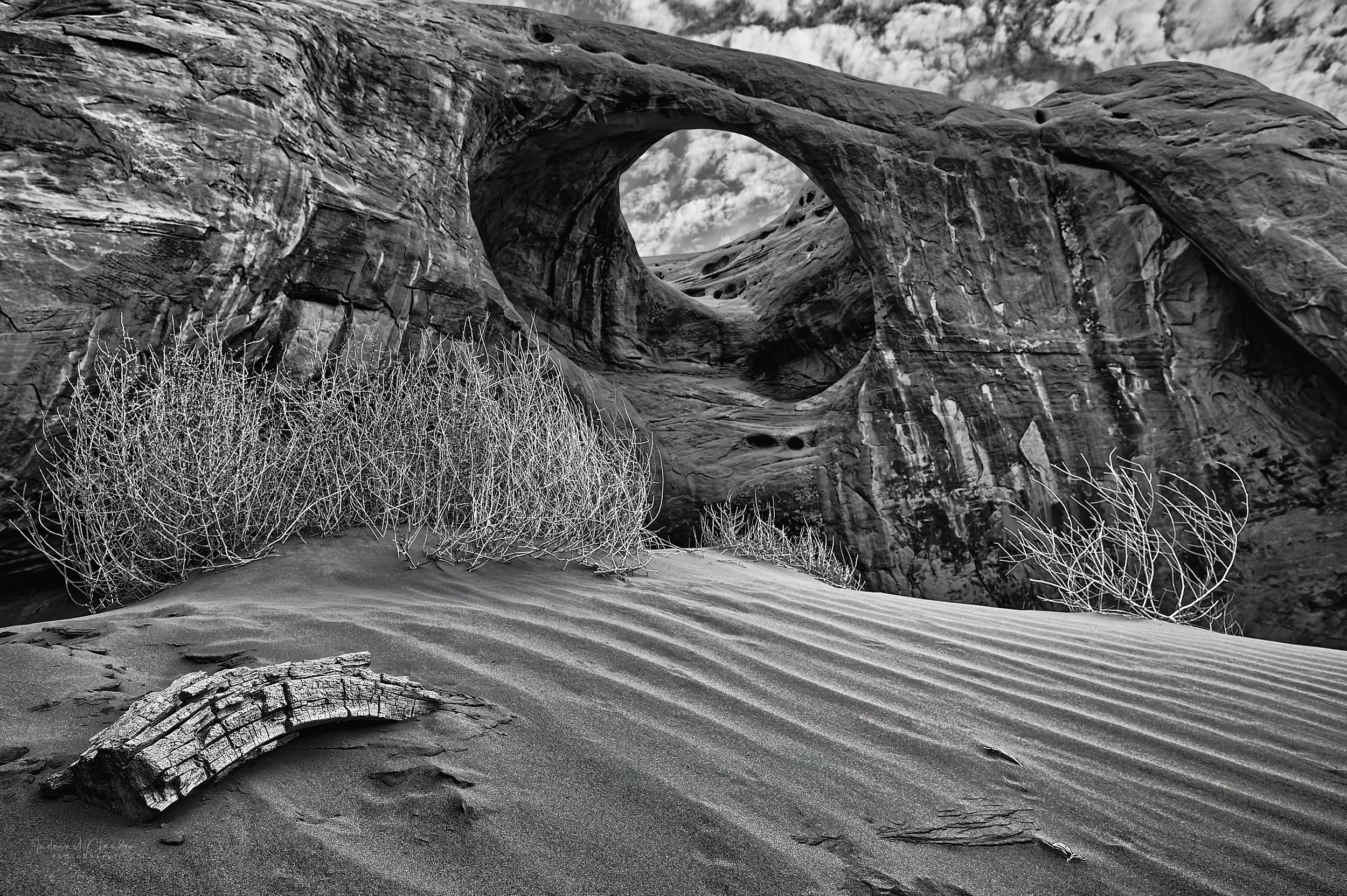
Moccasin Arch, a 30-foot opening in de Chelly sandstone in the backcountry of Monument Valley Navajo Tribal Park. Reaching it requires a Navajo guide — this is not on the self-drive loop, and the arch sees a fraction of the visitors the valley's famous buttes do. In black and white the image becomes a study in surfaces. The de Chelly sandstone is cross-bedded — laid down as wind-blown dunes some 250 million years ago, then cemented, and the diagonal lines of those ancient dunes are still legible in the rock face. Weathering has since pocked it with small hollows, and the arch itself is the end point of that process: water and wind working at a weakness until it opened right through. In the foreground the sand carries fresh ripples, and a piece of weathered wood sits where it came to rest. The whole frame is one substance at different stages — sand that became rock, rock returning to sand.
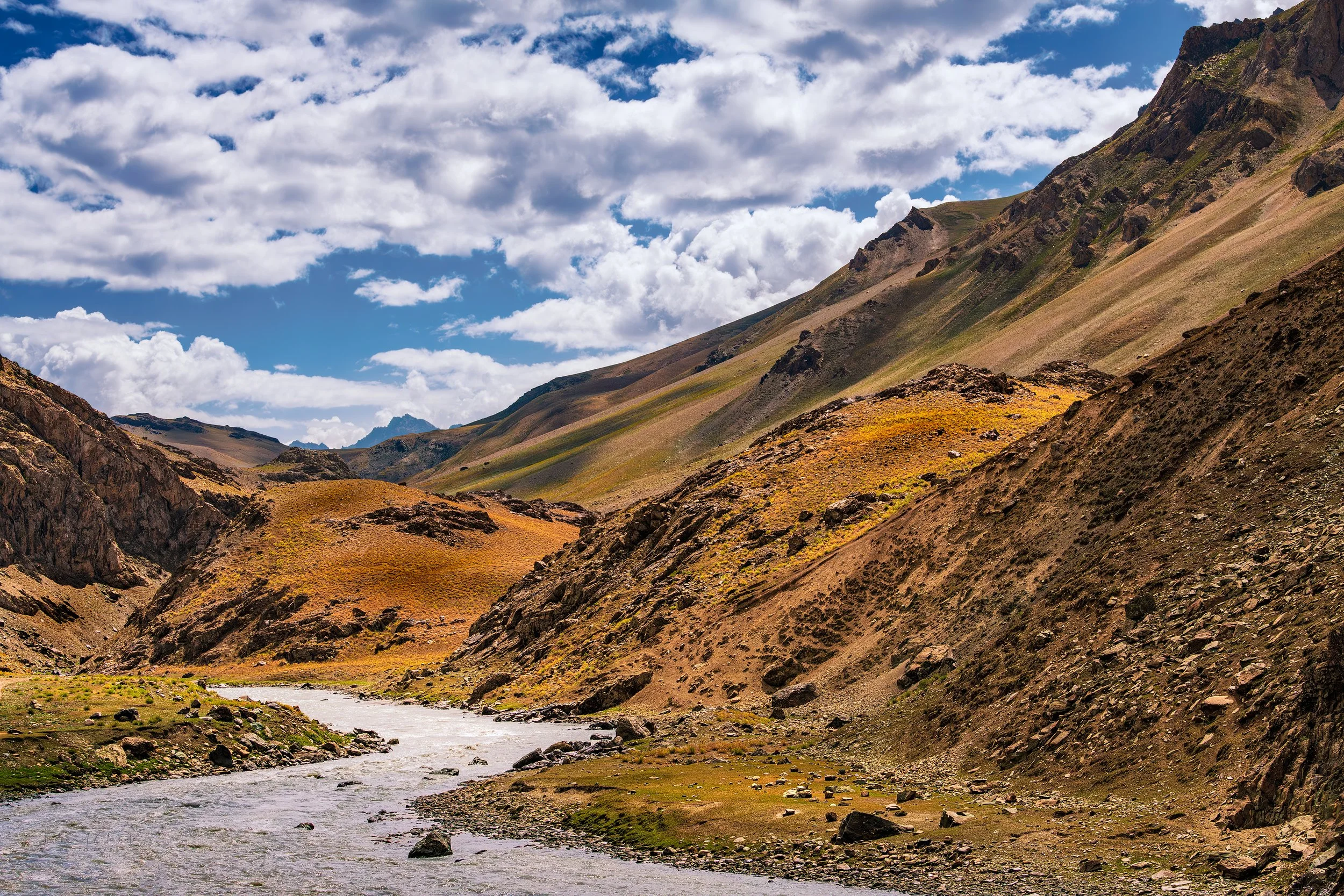
Made along the Srinagar–Leh highway from a moving car at 25 mph (40 km/h). There was no shoulder to pull onto and army trucks behind us, so there was no stopping — the picture is what the window offered as the valley opened up, taken in the second or two it stayed composed. The road runs high here, above the treeline, and the landscape has already begun turning from Kashmir's green toward Ladakh's dry mineral colour. The slopes shade from ochre through olive to grey-brown — thin soil over old rock, holding grass in the folds where meltwater runs and nothing at all where it doesn't. The stream is glacier-fed, milky with rock flour ground fine by ice upstream. Cumulus builds over the ridgelines, throwing patches of shadow that separate one slope from the next, and the light shifts fast enough that the same view a few minutes later would not have been the same picture.

The Cathedral Room in Upper Antelope Canyon, late morning in early July, and the reason people come here: a shaft of sunlight falling nearly vertically to the canyon floor. The beam is a matter of geometry and season. Upper Antelope runs roughly north–south and the opening at the top is only a few feet wide, so direct sun reaches the floor only when it's high enough to align — in practice from late spring into early autumn, and only for a window either side of midday. What makes the beam visible is dust: light passing through clear air leaves no trace, so without particles in suspension there is a lit patch on the floor and nothing between. The column you see is sunlight scattering off suspended sand. Around it, indirect light does the rest. Sun striking the sandstone above bounces down the walls, and each reflection warms the colour further — which is why the rock reads orange and red where light reaches and shifts toward violet in the shadows. The walls themselves are Navajo sandstone, cut into these fluted forms by flash floods scouring through the slot. The beam lasts minutes; the shape it falls on took millions of years.
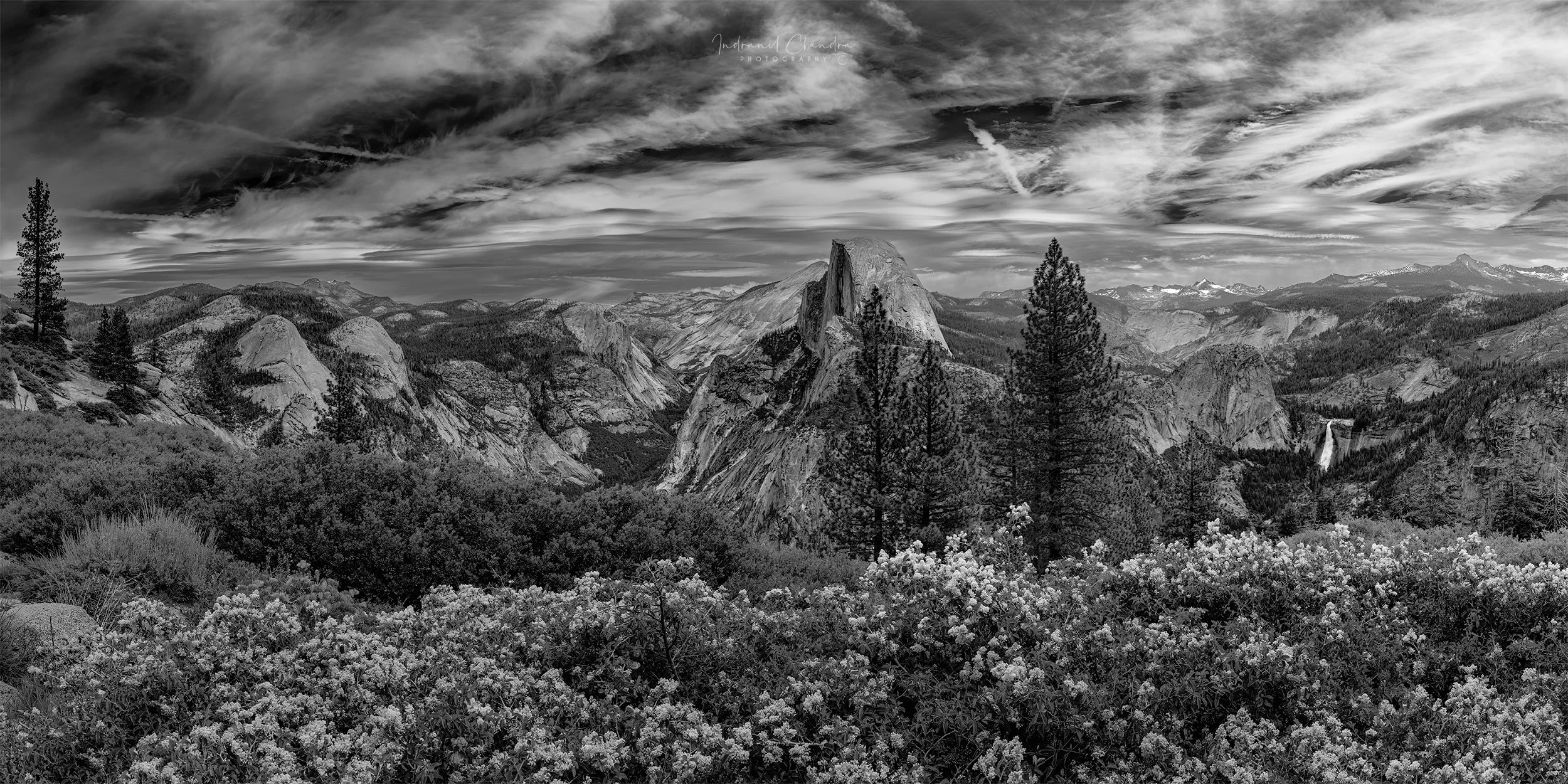
Half Dome from Glacier Point, six frames stitched into one panorama. I came up for the sky as much as the granite — high cirrus was raking across in long streaks, and in black and white that becomes the whole top half of the frame. Below it the Merced drops over Nevada Fall, buckbrush was in full bloom across the foreground, and the High Sierra crest held the horizon. The colour version never worked; monochrome let the cloud, the dome and the falling water carry it.

High on the Srinagar–Leh highway above Sonamarg, a dirt track cutting across the slope opposite. Trucks still ply this road. Made at 48mm — enough to lift this one section clear of its surroundings and let the slope fill the picture edge to edge.

A stretch of The Narrows in Zion, reached after a section where the water ran chest high — camera and tripod overhead — and then opened out onto this bank, where the river runs shallow again. The route through The Narrows is the river itself, and the depth changes with every bend, wherever the canyon pinches or the bed drops away. Here the canyon widens enough for plant life to hold. Cottonwood and box elder root wherever there's purchase, and above them the Navajo sandstone rises in a curved sweep, its diagonal cross-bedding still legible — dunes laid down some 190 million years ago, later cemented into rock. Warm light bounced off those upper walls turns the entire frame red, so green becomes the only cool note in it. The Virgin River is a small river doing outsized work. It cuts through sandstone at a rate that over time has left walls up to 2,000 feet high — and the boulders on the canyon floor are pieces of that wall, arriving one at a time.

First light on the Mesquite Flat dunes, Death Valley. At sunrise the sun comes in almost horizontally and every ridge throws its own shadow; an hour later the same dunes read as flat and featureless. Made with a 300mm lens, which is what stacks the frame the way it does — the telephoto compresses depth, pulling the Grapevine Mountains forward until they sit almost against the dunes rather than miles beyond them. The result is two opposed textures held in a single plane. Below: sand, smooth and continuously reshaped, its crests picked out in a bright line where the light catches. Above: rock eroded into a dense pattern of ridge and gully that changes on a scale of geological time. The softest surface in the valley set against the hardest, and the fastest-changing against the slowest. Death Valley's dunes are not migrating anywhere; they're trapped, held in a basin ringed by mountains that stop the sand from leaving. What moves is only the surface, remade by every wind.

Pangong Tso in early August, from the shore between Man and Merak — thirteen frames stitched into this single panorama. The peaks above still carry a little snow, thin and receding after the spring melt; by late summer most of the ridgeline is bare rock. The lake runs roughly 83 miles (134 km) across the high Ladakh plateau, its far end reaching well beyond the horizon in this frame.
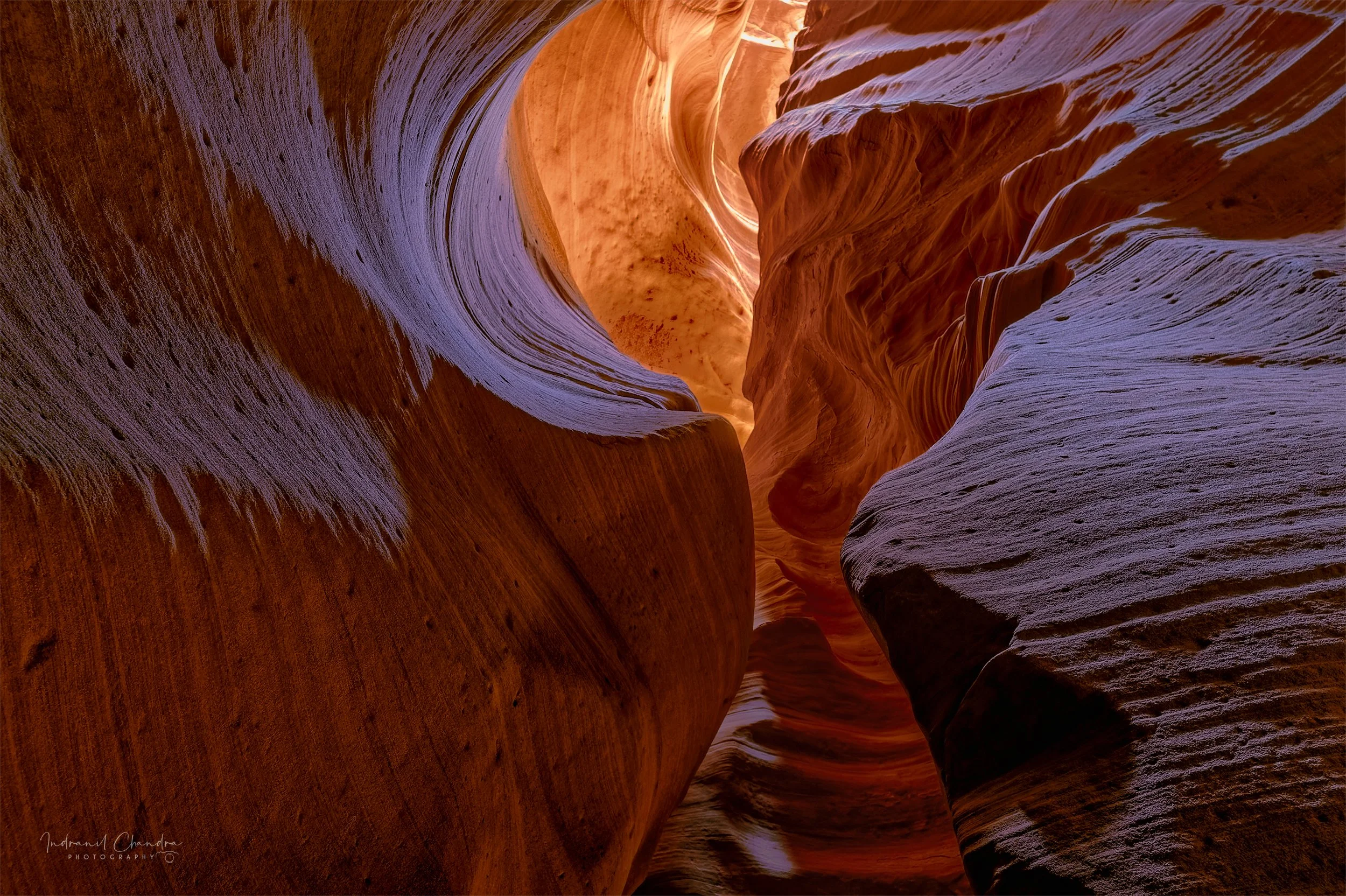
Canyon X, mid-morning, flat on my back on the canyon floor looking straight up. The camera saw more than my eye did: over a thirty-second exposure, light bouncing between the walls accumulated into the violets that sit against the fired orange above. Standing there, it read mostly as warm rock and shadow.
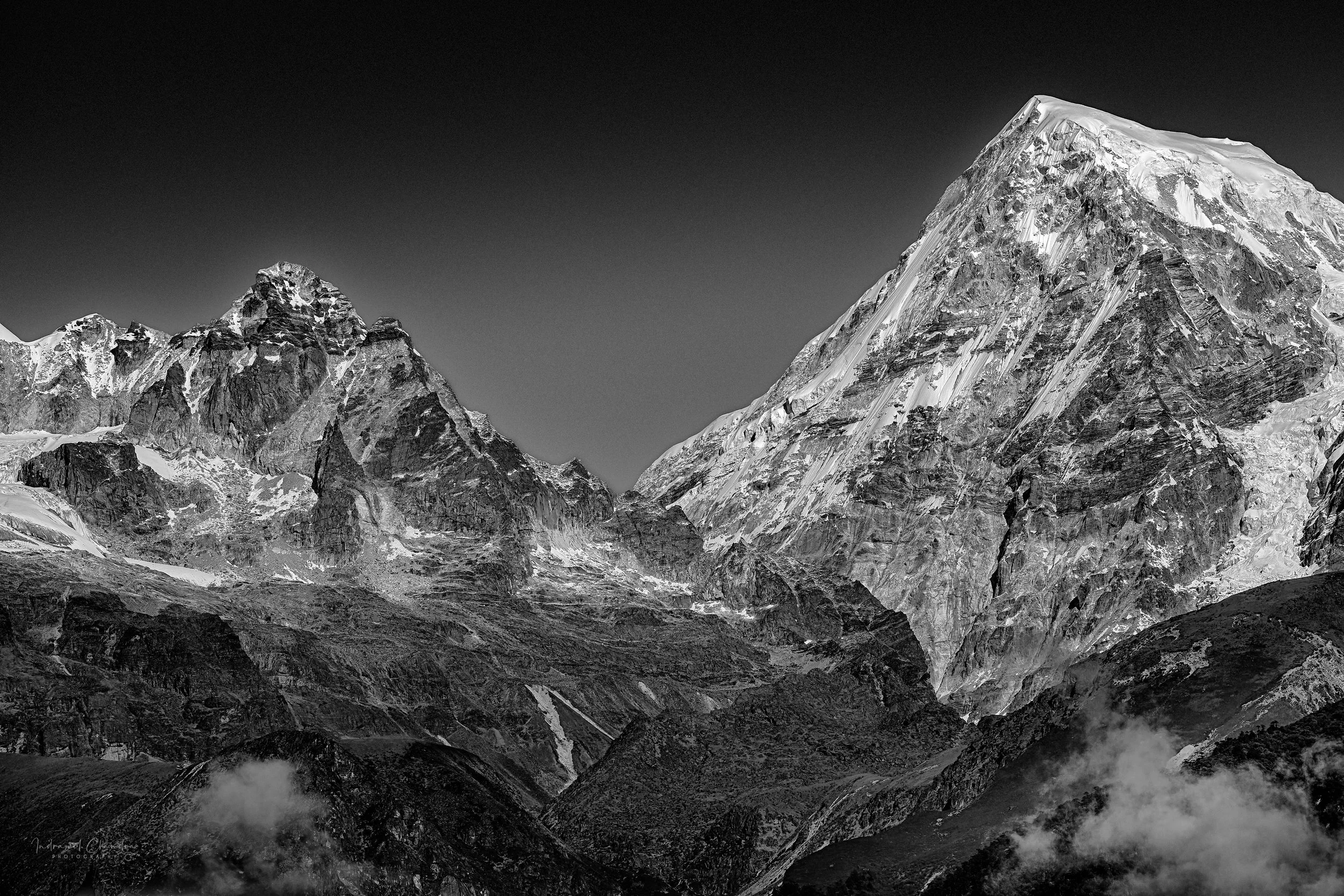
Mount Rathong, 21,910 feet (6,679 m), west of Kanchenjunga in the Eastern Himalaya. Photographed at first light from Pelling with a 500mm lens, which is what holds the detail across a face some 25 miles distant — every flute, serac and rock band on the summit pyramid rendered from a valley town. For all its accessibility to a camera, the mountain itself has barely been climbed. Rathong has had two ascents, in 1964 and 1987, both by way of the West Rathong glacier and icefall — the 1987 expedition mounted by twenty climbers of the 11 Gorkha Rifles of the Indian Army. The only viable line runs via the col between Kabru South and Rathong and then the knife-edged north ridge; the southeast holds a difficult icefall, the west a rocky ridge, and the south a steep overhanging face. A 2008 attempt on the southeast ridge reached around 20,700 feet before very strong winds and low temperatures turned the party back. From Pelling the mountain reads as pure form — light on ice, shadow in the couloirs, a shape that resolves cleanly in a single morning's light. What the photograph cannot show is how few people have stood on top of it.

Antelope Canyon, in a stretch where no direct sunlight reaches the walls. Everything here is second-hand light: sun striking the rim far above, then bouncing down from surface to surface. Each reflection off the sandstone strips more blue from it, so the light arrives warmer with every bounce — gold where it has travelled fewest surfaces, deepening to violet and blue in the recesses where almost none of that reflected warmth reaches, and what remains is the cooler light falling from open sky above. The forms are the record of moving water. Flash floods funnel through these slots carrying sand, and over long periods that suspension has scoured the sandstone into flutes, scallops and folds — shaped by flow, which is why rock this hard reads as liquid.
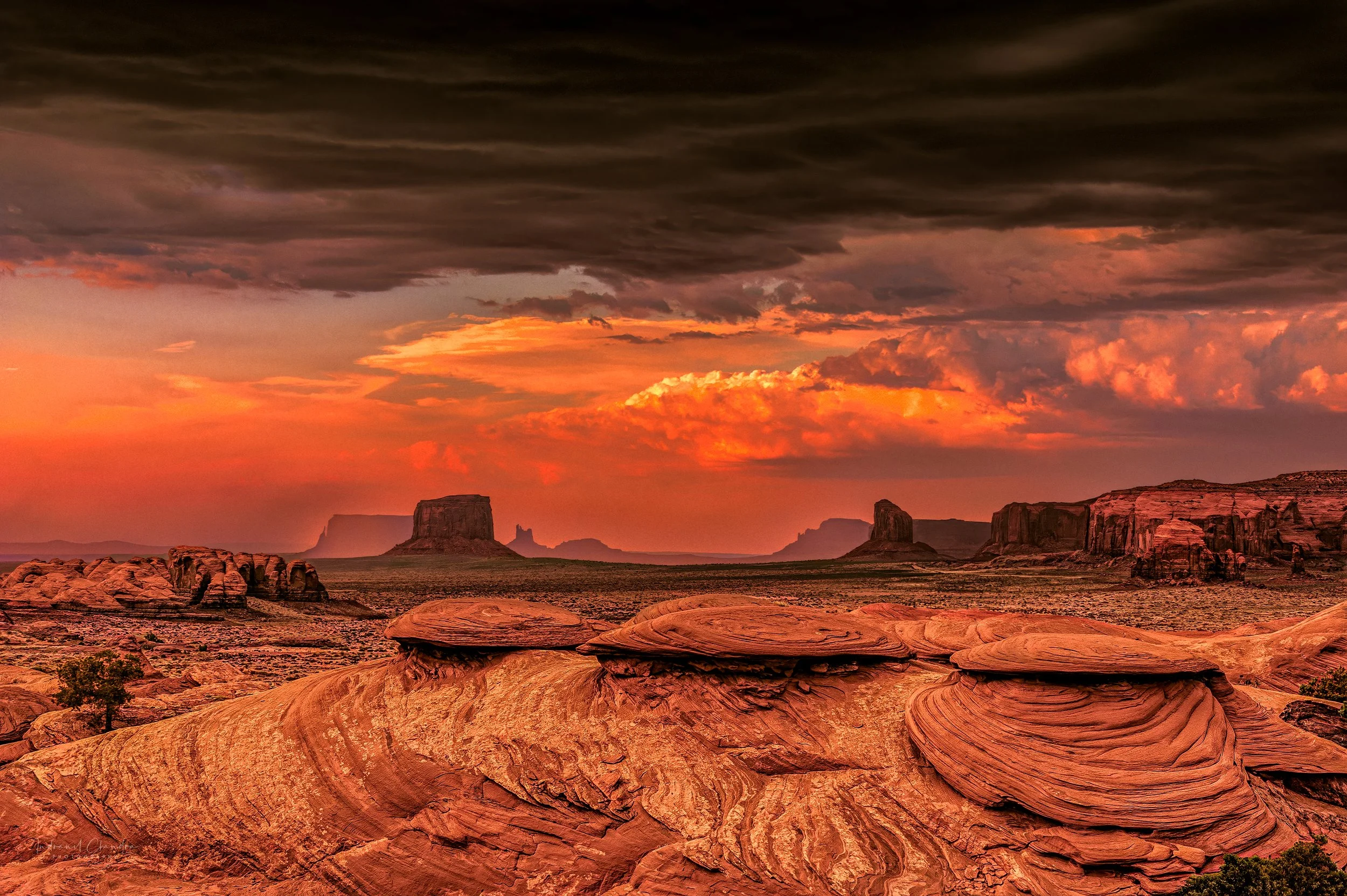
Storm light over Monument Valley, seen from Mystery Valley — the park's backcountry, which can only be entered with a licensed Navajo guide. Navajo families live in this section, and the buttes on the horizon are the formations most people photograph from the other side. A retreating cell had left cloud stacked across the whole sky, and the sun, dropping below its base near the horizon, was lighting it from underneath — which is why the cloud burns orange while the ground stays comparatively dim. It needs a narrow gap in conditions: the storm has to have passed, but the western horizon has to stay clear enough for the last light to slide in beneath it. The light on the sandstone in the foreground does the rest. The storm was not finished. Lightning was still coming down, and I made this frame and went straight back to the car — standing on exposed slickrock with a tripod is not a position to hold. The best light of the day and the reason to leave arrived together.
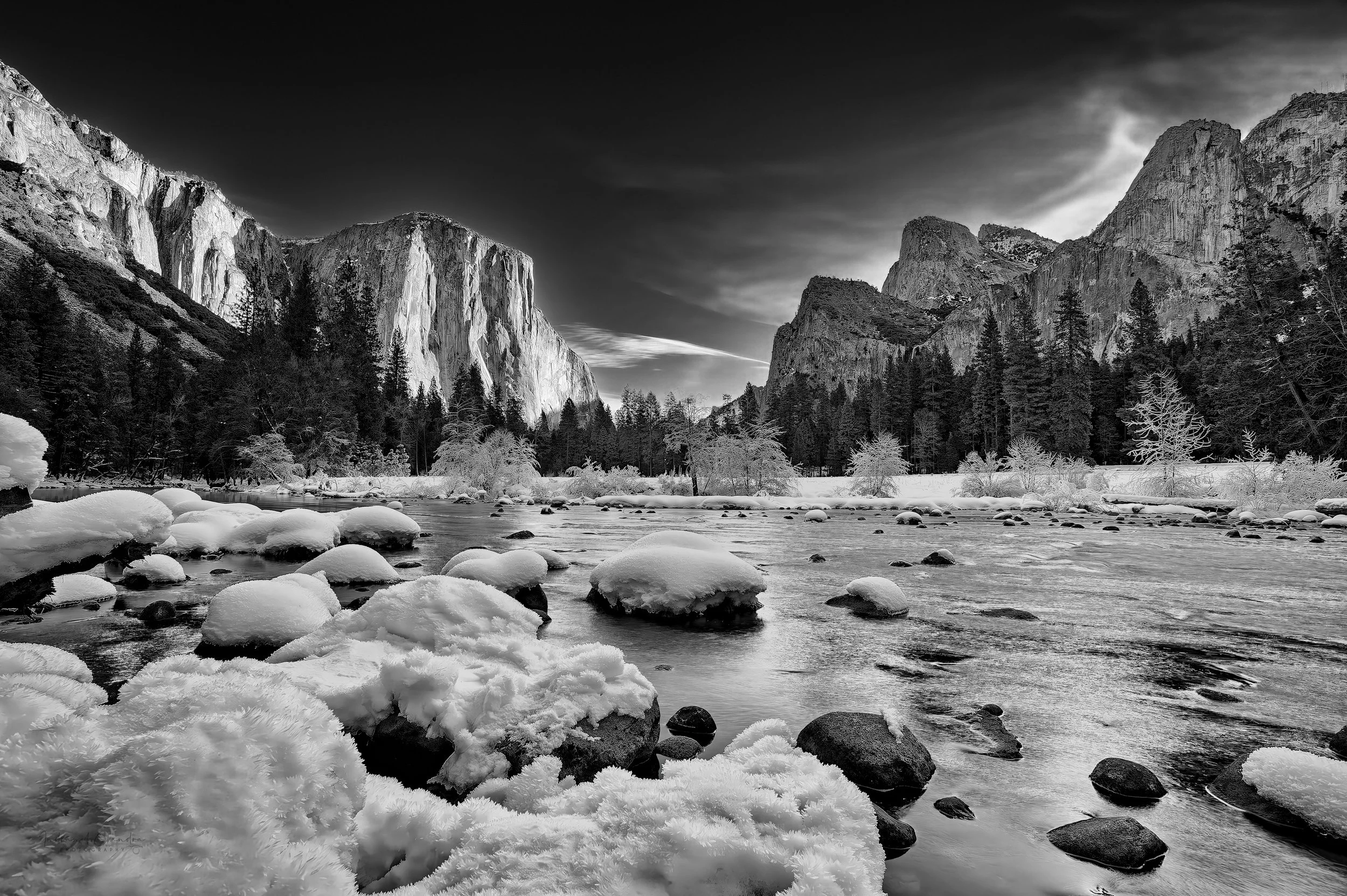
Snow on the boulders of the Merced, with El Capitan on the left and Cathedral Rocks standing over the far end of the valley — Yosemite on a winter morning after a storm had cleared. Overnight the snow had grown a coat of feathered crystals: surface hoar, which forms only on cold, still, humid nights and lasts until the first wind or direct sun finds it. I worked low and close to the water to keep that texture in the near frame. Valley View puts two very different clocks in a single frame. The granite is roughly 100 million years old, cooled miles underground and later lifted and stripped bare; glaciers grinding through the valley in the ice ages squared off its sides and left El Capitan's face standing about 3,000 feet (900 m) above the river. The crystals in the foreground took one night to build and were gone by afternoon. The frame holds the entire span of that morning's light — from a sky rendered nearly black at the top edge, down through granite still in shadow, to snow lit hard enough to be the brightest thing in the valley — with texture surviving at both ends. No blank white in the drifts, no flat black in the trees, and at size the hoar stays crystalline rather than collapsing into a white mass.
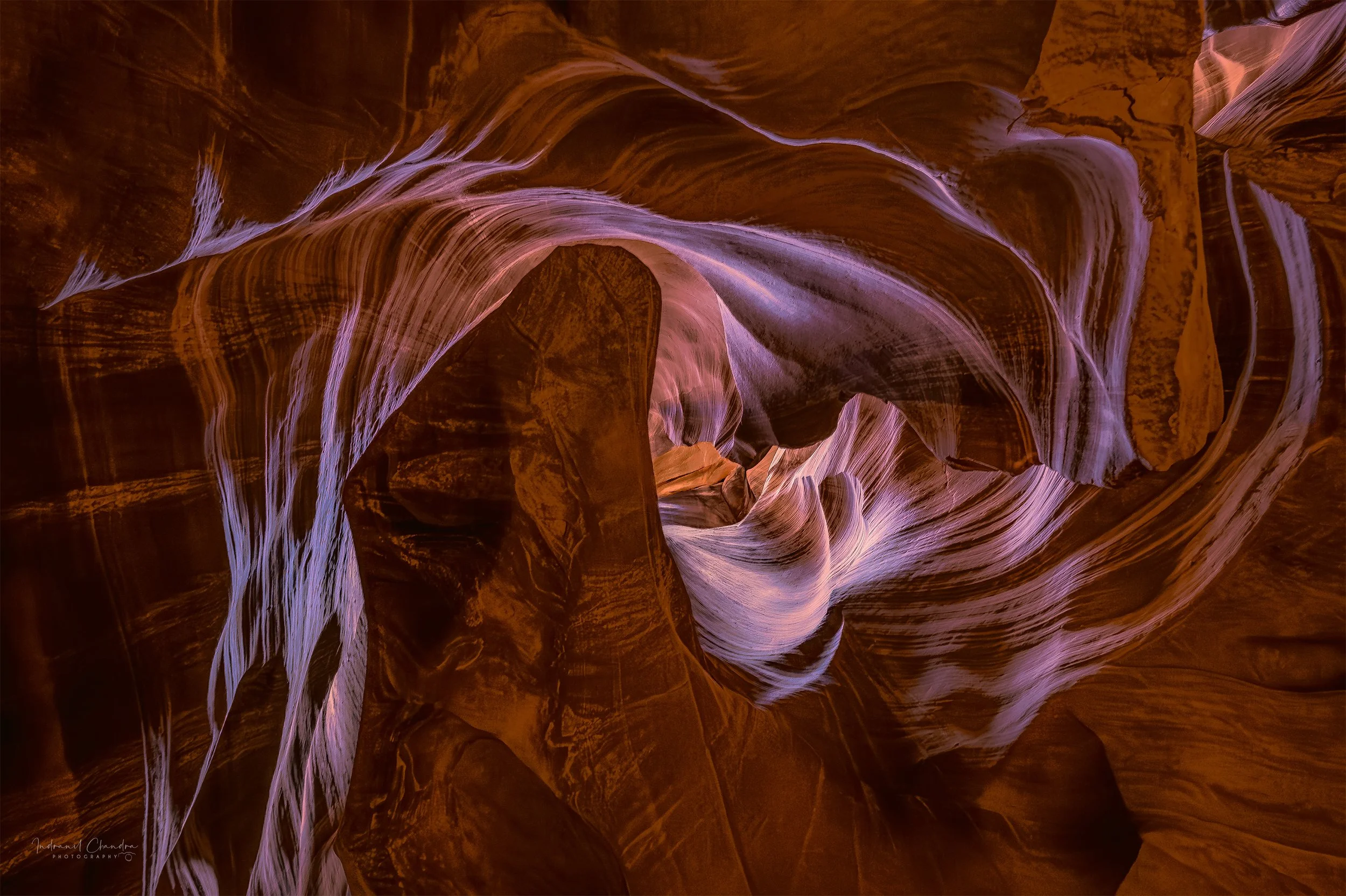
July 2011, deeper into Upper Antelope — Tsé bighánílíní to the Navajo, "the place where water runs through rocks." Here the walls close overhead and the passage turns back on itself. A single patch high in the fold catches direct sun; everything else in the frame is lit only by what bounces off it. The camera is on a tripod, pointed up into the fold, gathering light over several seconds; nothing in a slot canyon moves, so the time buys detail rather than blur. There's no floor in the frame and nothing to indicate which way is down. Tripods have since been banned in the canyon. That lit patch is the source for everything else. Light striking it scatters to the surrounding walls, and each bounce subtracts the cooler wavelengths and leaves the warmer ones — so colour here is a function of how far the light has travelled from that one point: fired orange where the sun lands directly, ochre and gold a bounce away, violet and near-grey deep in the folds where almost nothing gets through. It's also why the surfaces read as continuous form. Away from the lit patch, light arriving from every direction at once casts no hard shadow, so the sculpted rock shows as gradient rather than edge, and the eye follows the curve before it registers stone.

Kanchenjunga, from Pelling, West Sikkim, at first light. The valleys were dark, the ridges were dark, the sky was still holding its overnight colour — only the top of the massif had caught the sun. Made with a long telephoto to bring the summit ridge close and crop away everything that wasn't lit, and composed as a panorama because that was the shape the light made: a narrow horizontal band, and almost nothing else. Kanchenjunga is not a single summit but five, and its name means the five treasures of the great snow — gold, silver, gems, grain and holy scripture, said to be held there. At this hour the earth's own shadow still lies across the range, retreating downward as the sun climbs, so illumination is confined to the highest few hundred feet (100 m); the peaks stand lit for several minutes before the ridges just below them see anything at all. That gap is the entire picture — a strip of bright snow set against dark rock and darker sky, the subject occupying a small fraction of the frame and everything else left to sit empty. Printed long and narrow, that restraint is what makes it work: one horizontal gesture read across a room, and close up, the lit snow holding its structure — cornices, ridge lines, the shadowed gullies between them.
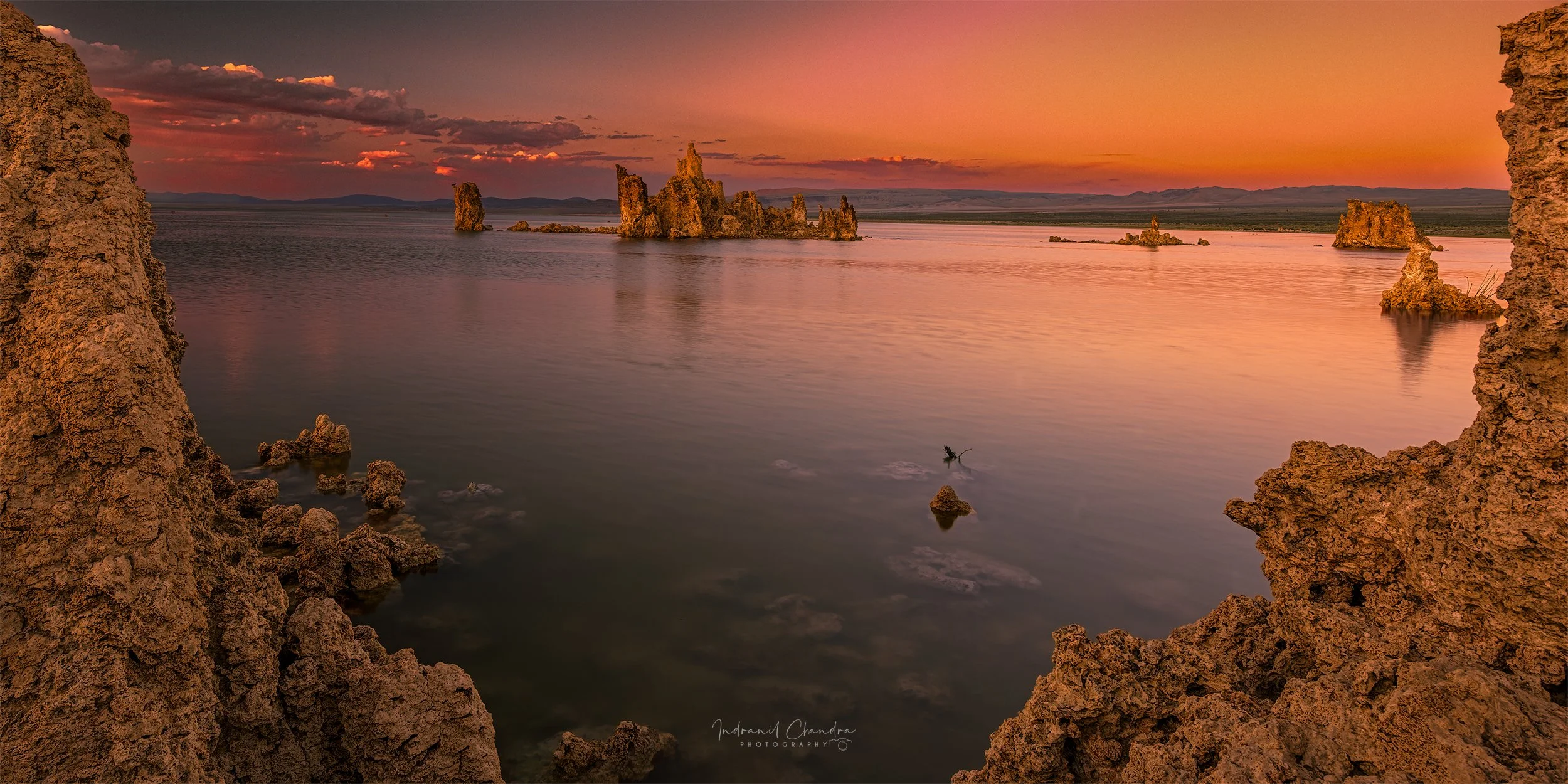
Mono Lake at sunset, from among the tufa on the south shore. Two towers hold the edges of the frame, and between them the lake opens out — mid-lake formations catching the last of the light, then the far shore, then the low hills of the Mono Basin beyond. A long exposure has smoothed what little movement there was into something closer to glass.